• Skip to main content
  • Skip to primary sidebar

Collect911

  • Home
  • Pricing
  • Contact Us

debt

Collection Agency Market Overview

For a collection agency sales rep, “busy” is easy. “Productive” is hard. The pipeline can be full of leads, but if they don’t convert, it’s just motion. The difference between a struggling agency and a high-growth one often comes down to where they hunt for new business.

Not all lead sources are created equal. Some deliver high-volume, low-quality prospects, while others deliver fewer, high-value clients that anchor your business for years. After analyzing the common channels, a clear hierarchy emerges.

The highest-quality wins, in terms of conversion rate and client value, come from sources built on trust. The most scalable wins come from integration and intent.

Here is a breakdown of the six primary lead channels, ranked from highest to lowest in terms of conversion quality.

collection agency lead generation

1. Referrals (Client & Network)

This is the undisputed king of lead quality. When an existing client or a trusted colleague refers new business, they are transferring their established trust over to you.

  • Pro: The sales cycle is dramatically shorter. Objections about trust and performance are often handled before you even have the first meeting. The acquisition cost is virtually zero.
  • Con: This channel is entirely passive and unpredictable. You cannot build a sales forecast on hope.
  • The Reality: You cannot control referrals, but you can encourage them. A formal referral program that offers incentives (like a service discount or a simple, high-quality gift card) moves this from a “passive hope” to an “active strategy.” You must make it easy for your best clients to recommend you.

2. Strategic Partnerships (Software & Associations)

This is how you scale trust. By becoming the endorsed partner for a state dental association or integrating directly with a popular medical billing software, you become the default, pre-vetted solution.

  • Pro: It creates a powerful “moat” around your business. You are embedded in the client’s workflow or professional community, making you the path of least resistance. It generates a steady flow of warm, high-quality leads.
  • Con: The sales cycle to win the partner is extremely long and complex. You aren’t just selling collections; you’re selling compliance (HIPAA, FDCPA), reliability, and a partnership. It may also require revenue sharing.
  • The Reality: This is a high-stakes B2B sale. You must have your technical (API integrations) and compliance (data security) documentation in perfect order. This is a long-term play, not a quick win.

3. Inbound Leads (Website, Google Reviews & SEO)

These are “hand-raiser” leads. The prospect has a problem right now, and they are actively searching for a solution. They are telling you they have a need.

  • Pro: The prospect’s intent is high. They are already qualified in the sense that they are problem-aware and solution-shopping.
  • Con: This channel is fiercely competitive. You are bidding against every other agency on Google. It can also attract low-quality leads (e.g., individuals with a single small debt, or businesses that have waited too long).
  • The Reality: A professional website is just the start. The real engine here is social proof. An agency with 50 positive Google Reviews will beat an agency with 2 every time. Your online reputation is your new frontline sales tool.

4. Cold Outbound (Calls & Emails)

This is the classic, high-volume “hunter” model. It is the only channel where you have 100% control over the activity level.

  • Pro: It is infinitely scalable. If you have the reps and the data, you can contact thousands of potential clients. It’s excellent for targeting a very specific new vertical.
  • Con: The conversion rate is brutal. Trust is at zero. You are an interruption, not a solution. It can also damage your brand if your outreach is spammy or unprofessional.
  • The Reality: This is a numbers game that requires relentless persistence, thick skin, and a dedicated rep (SDR). Compliance with the TCPA and CAN-SPAM is not optional. The goal of a cold call isn’t to sell the service; it’s to sell the 15-minute meeting.

5. Trade Shows & Conferences

This is a niche-specific strategy. If you specialize in (for example) B2B manufacturing or dental practices, being at their industry show puts you directly in front of decision-makers.

  • Pro: Unmatched face-to-face access. You can have conversations in two days that would take six months of cold calling to secure.
  • Con: It is extremely expensive. Booth fees, travel, and marketing materials add up quickly, and the ROI can be difficult to track.
  • The Reality: The “win” is never at the show itself. The win is in the post-show follow-up. It requires a strict, systematic process to turn a badge scan into a qualified meeting.

Final Verdict: Build a Balanced Strategy

Relying on any single channel is a mistake.

  • Relying only on Referrals makes your growth unpredictable.
  • Relying only on Cold Outbound leads to high sales-rep burnout.
  • Relying only on Inbound makes you vulnerable to competitors with bigger marketing budgets.

The most successful agencies use a balanced approach: Cold Outbound and Inbound Marketing fill the top of the sales funnel, while high-trust Referrals and Partnerships are cultivated to land the game-changing, long-term clients.

Filed Under: debt

Recover Rent Faster: Student Apartment Collection Agency

Every landlord eventually deals with a tenant who disappears. Student housing is the only rental market where it happens on a schedule: same week every May, same names, same forwarding address that’s really just “wherever mom and dad live now.” By the time a balance shows up on your books, half your leverage already left with the diploma. We built our recovery process around that calendar, reaching parents and guarantors while they’re still reachable, and tracking graduates before their trail goes cold.


Stages when a student defaults on his apartment rent or does not pay the damages

Why Apartment Owners Near Colleges Struggle with AR—and How Collect911 Fixes It

Let’s be honest. Renting to students can feel like riding a rollercoaster. Some pay on time, some disappear after finals week, and others argue over every little fee. Apartment managers near colleges face a very different world than traditional landlords. The tenants are young, inexperienced, and often cash-strapped. And when payments fall behind, chasing money across state lines—or across parents—becomes exhausting.

That’s where Collect911 steps in. We’re not just another collection agency—we’re a partner licensed to collect nationwide, offering low-cost fixed-fee reminders, standard collection calls, and full legal support when needed. Best part? We do all this while protecting your reputation. Our clients trust us because we’ve earned a 4.85-star rating from over 2,500 Google reviews.

Need an Experienced Collection Agency: Contact us


1. Irregular or Missed Rent Payments

Students live paycheck-to-paycheck or wait for financial aid refunds. Rent shows up late… or not at all.
✅ Collect911 Advantage: We send fixed-fee reminders early in the cycle so delinquent balances don’t snowball. When accounts do escalate, our professional but firm collection calls make sure parents and students know rent isn’t optional.


2. High Turnover and Short Leases

Nine months go by, and your tenants are gone—with unpaid utilities, last month’s rent, or cleaning costs left behind.
✅ Collect911 Advantage: We’re experts in quick recovery before students scatter. With our skip tracing tools, we track graduates even after they’ve moved to another city—or another state.


3. Parents as Guarantors / Cosigners

Leases may name parents as guarantors, but enforcing that can feel awkward for apartment staff.
✅ Collect911 Advantage: We handle that for you. Our collectors contact guarantors directly, explaining liability clearly and respectfully. This takes the stress (and the tension) off your plate, while still ensuring payment.


4. Utility Bills and Roommate Drama

“He didn’t pay his share.” “I already gave her the money.” You’ve heard it all before.
✅ Collect911 Advantage: We cut through the noise. By addressing all leaseholders and guarantors, we prevent finger-pointing and focus on recovering the balance owed—fast.


5. Damages Beyond Deposits

Security deposits rarely cover destroyed furniture, holes in walls, or stained carpets after student parties.
✅ Collect911 Advantage: Our legal escalation services allow us to pursue damages that go far beyond deposits. Parents take notice when a legal letter arrives—balances that once felt “optional” suddenly get paid.


6. Hard-to-Find Tenants After Graduation

Students move. Often overnight. Sometimes across the country.
✅ Collect911 Advantage: Collect911 uses advanced skip tracing to find them. Even if they vanish, we track them down—protecting your property’s bottom line.


7. Lease Disputes and “I Didn’t Understand” Excuses

Students claim they didn’t realize joint leases meant full liability. Parents dispute early termination fees. These standoffs delay payments.
✅ Collect911 Advantage: With clear documentation and legal expertise, we settle disputes before they spiral. We speak the language of compliance and law—making it harder for tenants or parents to dodge responsibility.


8. Protecting Your Reputation

Aggressive or careless collections can tank your apartment community’s reputation online. One angry parent review can scare off dozens of future tenants.
✅ Collect911 Advantage: We’re firm, but never reckless. Every contact we make reflects back on you. Our goal? Get you paid without ever putting your reputation at risk.


Why Collect911 is Different

  • Nationwide Licensed – We pursue guarantors and tenants no matter where they move.

  • Flexible Options – From low-cost fixed fee services to contingency collections, we have a solution for every account stage.

  • Legal Backing – When a lawsuit or judgment is the right move, we’ve got the network to handle it.

  • Proven Trust – A 4.85 Google rating with 2,500+ reviews means thousands of clients already rely on us to protect their business.

Cost of collections. Contingency and fixed fee services.


Frequently Asked Questions: Student Rent & Housing Collections

Q: How does Collect911 handle collections when a parent or guarantor signed the lease?

A: We initiate dual-outreach tracking to both the primary student tenant and the signed parent or third-party guarantor simultaneously. Because over 80% of student leases rely on parental financial guarantees, our skip-tracing tools immediately verify the current contact information and asset profiles of both parties. Resolving balances with financially established guarantors is often the fastest path to full debt recovery.

Q: How do you handle high-volume turnover balances following the August lease end?

A: Student housing operates on intense 12-month academic cycles, creating massive spikes in unpaid balances during the July/August turn season. Collect911 offers bulk batch-upload capabilities that allow property managers to hand off dozens or hundreds of post-turnover accounts at once. Our automated early-intervention phase ($15 fixed fee) reaches tenants right after move-out, securing payments before former students relocate or change contact details.

Q: What happens when there is a roommate dispute over joint and several liability?

A: Roommate ledger disputes are common in multi-bedroom student units. Collect911 audits your property management ledger breakdowns (e.g., AppFolio, RealPage, Entrata) to isolate individual tenant balances versus joint liabilities. We communicate transparently with each tenant to resolve individual balance shares quickly without getting bogged down in internal roommate disagreements.

Q: Can Collect911 recover property damage fees that exceed the security deposit?

A: Yes. When move-out inspection reports reveal unit damages that surpass the tenant’s security deposit, we collect on the remaining unpaid ledger balance. As long as the charges are documented in your itemized move-out statement and backed by your lease agreement, we pursue the full remaining balance from both the tenant and guarantor.

Q: Does Collect911 attempt to settle student housing debts out of court?

A: Yes. Our primary objective is always to resolve delinquent rent, lease breaks, and damage fees through professional mediation, firm negotiation, and credit reporting leverage out of court. This avoids expensive litigation, saves property managers thousands in legal fees, and delivers faster cash flow recovery.

Q: How does reporting delinquent rent to credit bureaus impact recovery rates?

A: Reporting unpaid housing balances and lease breaks to national credit bureaus provides significant leverage. Young adults entering the workforce or seeking future housing, auto loans, or credit cards are strongly motivated to clear negative marks from their credit reports. This often leads to full balance payoffs or voluntary settlement arrangements.


👉 Renting to students will always be unpredictable. But your accounts receivable doesn’t have to be. With Collect911, you get a partner who recovers faster, costs less, and safeguards your reputation while doing it.

Request a Quote: Contact us

Filed Under: debt

Optometry Collection Agency: Recovering Unpaid Patient Bills

For an Optometrist, every unpaid bill is a double loss. You aren’t just losing the fee for a clinical exam; you are often out the “cost of goods sold” for high-end frames and specialized lenses. Unlike a general practitioner, your practice operates as both a medical clinic and a retail boutique. When a patient walks out with a $600 pair of progressive lenses and never pays the balance, it’s a

An unpaid eye-care bill is not always a simple patient balance. Was the visit a routine vision exam or a medical eye exam? Did insurance process the claim correctly? Was the refraction or contact-lens fitting excluded from coverage? And is the practice trying to collect for professional care, eyewear, or both?

Collect911 helps optometrists and ophthalmologists sort out valid patient responsibility before collection begins, so an insurance problem does not become a patient dispute. Fresher, well-documented balances can enter our $15 fixed-fee collection program, while older or more difficult accounts can move to contingency collections. The goal is to improve A/R without damaging the patient relationship. Our 4.8-star Google rating reflects our ability to recover funds while maintaining the patient-doctor relationship.

Optometrist collection agency helping eye care practices recover unpaid patient balances through HIPAA-compliant fixed-fee and contingency collections.

Protecting your reputation, Collect911 holds licenses in all 50 states, ensuring a safe approach for every member interaction. We provide free litigation and bankruptcy scrubs with zero onboarding or annual fees. Our SOC 2 Type II and HIPAA-compliant systems ensure total data security, backed by a 4.85/5 rating from over 2,000 professional reviews. Delivering high recovery rates!

Need a Optometry Collection Agency? Contact us


Our Proven 3-Step Recovery Process

We don’t believe in a “one-size-fits-all” approach. We offer a tiered strategy that allows you to choose the level of intensity based on the age of the debt.

Step 1: The Diplomatic Phase (Fixed-Fee)

This is designed for “good” patients who have simply overlooked a bill. For a low fixed fee (often less than $20 per account), we send a series of professional, third-party demand letters.

  • The Benefit: You keep 100% of the money recovered. Patients pay directly to you.

  • The Goal: To nudge the patient without “burning the bridge.” It signals that your billing office is organized and serious.

Step 2: Intensive Recovery (Contingency)

If the patient ignores the initial letters, the account moves to our intensive recovery phase. This involves skip-tracing, phone contact, and more assertive negotiations. No recovery means No fee.

  • Pricing: 15% to 40% contingency.

  • No Risk: If we don’t collect, you owe us nothing. We only get paid when you do.

Step 3: Final Escalation & Credit Reporting

For the most stubborn accounts, we move to the final tier. Where legally permitted and authorized by you, we report the delinquency to major credit bureaus. This is often the ultimate “trigger” that forces a patient to pay when they attempt to apply for a mortgage or auto loan.

Collection agency fee of Collect911


Why Optometrists Trust Collect911

1. Industry-Specific Experience

We understand the difference between a co-pay, a “refraction fee,” and a retail balance for materials. Our team knows how to speak to patients about their vision plans and why they owe the remaining balance.

2. Reputation Protection

In a small community, one “aggressive” collector can lead to a string of 1-star reviews for your practice. We pride ourselves on being firm but professional. We act as an extension of your office, not a “heavy-handed” debt collector.

3. High Recovery Rates

By moving accounts to us early (ideally between 60-90 days), our clients see recovery rates significantly higher than the industry average. We turn your “bad debt” back into liquid cash flow.

4. Verified Transparency

Our 4.8-star rating isn’t just a number—it’s a testament to our transparency. You’ll have access to a portal where you can track every dollar recovered in real-time.

optometrist unpaid bill collection


Recent Recoveries

Independent Optometry Practice — Fixed Fee — 72% Recovered

A practice submitted $13,250 in recent deductibles, refraction fees, and patient balances after payer processing was complete.

Recovered: $9,540 — 72% recovery rate

Ophthalmology Group — Contingency — 51% Recovered

An ophthalmology group placed $34,800 in older post-insurance balances after routine billing follow-up had stalled.

Recovered: $17,748 — 51% recovery rate

Multi-Location Eye Care Practice — Fixed Fee + Contingency — 46% Recovered

A multi-location practice referred $25,500 in mixed-age patient A/R. Fresher balances started fixed-fee; difficult older accounts moved to contingency.

Recovered: $11,730 — 46% recovery rate


Frequently Askes Questions

Should an optometrist bill the patient’s vision plan or medical insurance before sending an unpaid balance to collections?

It depends on why the patient was seen and what services were provided. A routine refractive or vision examination is generally handled through the patient’s vision plan, while an examination involving an ocular disease or medical complaint—such as glaucoma, dry eye, infection, cataracts, or diabetic eye disease—may need to be billed to the patient’s medical plan. Before moving a balance to collections, the practice should verify that the appropriate plan was billed, the claim was adjudicated, and the remaining deductible, copay, coinsurance, refraction fee, or non-covered service is genuinely the patient’s responsibility.

Can an optometrist withhold an eyeglass or contact-lens prescription because the patient still owes money?

Federal rules significantly restrict this practice. After a qualifying refractive examination or completed contact-lens fitting, optometrists and ophthalmologists generally must provide the patient with a copy of the prescription without charging an additional prescription-release fee or requiring the patient to purchase eyewear or contact lenses from the practice. A practice may require payment for the examination before releasing the prescription only under limited conditions, including when it routinely requires immediate payment from all comparable examination patients. An old unpaid balance should therefore be pursued through the billing and collection process rather than by improperly withholding a prescription.

What if a patient says their vision insurance should have paid an optometry bill that is now overdue?

Review the claim before treating the amount as bad debt. Vision plans and medical plans can cover different parts of an eye-care encounter, and coordination of benefits can be particularly complicated in optometry. For example, a medical eye examination may be billed to medical insurance first while an eligible vision benefit may later help with certain uncovered portions, depending on the plan. The practice should review the EOB, payer contract, claim status, coordination-of-benefits requirements, and the patient’s true responsibility before referring the balance for collection.

Can a self-pay eye-care patient dispute a bill that is much higher than the estimate?

Yes, in qualifying cases. Under the federal Good Faith Estimate rules, uninsured patients and patients who choose not to use insurance generally must receive an estimate for scheduled healthcare services. If a provider’s final bill is at least $400 more than that provider’s Good Faith Estimate, the patient may qualify for the federal Patient-Provider Dispute Resolution process if the other requirements are met. While a qualifying dispute is pending, the disputed bill cannot be moved into collections, and existing collection activity on that disputed amount must stop.

Does an optometry practice need to send the patient’s entire eye chart or retinal images to a collection agency?

Usually not. HIPAA permits healthcare providers to use collection agencies as part of their payment activities, but the minimum necessary rule generally requires the practice and its business associate to limit protected health information to what is reasonably necessary for collection. A typical collection file may need identifying information, the amount owed, dates of service, billing records, insurance disposition, and supporting documentation—but that does not mean the collector automatically needs the patient’s complete clinical record, retinal images, or unrelated diagnoses.

Can a collection agency contact a parent or guarantor about a child’s unpaid eye-care bill?

Yes, when appropriate for obtaining payment, but the practice should first confirm who is actually financially responsible for the account. HIPAA allows a healthcare provider or its business associate, including a collection agency, to communicate with another person as reasonably necessary to obtain payment for healthcare. Any disclosure must still be limited appropriately, and applicable confidential-communication requests and other legal restrictions must be respected. Accurate guarantor information is therefore especially important before pediatric optometry balances are transferred for collection.


Stop Letting Your Profits Walk Out the Door. Don’t let “one more month” of promises turn into a total loss. Whether you need a low-cost letter service or an assertive recovery team, we have the tools to secure your practice’s financial future.

Contact Collect911 Today for a Free AR Analysis

Filed Under: debt

Challenges and Considerations in Commercial Credit Reporting

Accessing and utilizing commercial credit reports is vital for managing credit risk in business-to-business (B2B) transactions. Here’s how businesses can effectively leverage these reports:

How to Access and Use Commercial Credit Reports

  1. Determining Creditworthiness: Before extending credit or entering significant contracts, order a commercial credit report to assess potential risks. These reports offer a comprehensive view of a business’s credit history, including payment trends, outstanding debts, bankruptcies, and court judgments.
  2. Credit Monitoring: Subscribe to ongoing monitoring services from commercial credit bureaus. Receive alerts on changes in a customer’s credit status—like new liens, judgments, or shifts in creditworthiness—allowing you to proactively adjust credit terms based on their financial stability.
  3. Improving Your Business Credit: Understand the factors that contribute to a strong credit report. Enhance your own creditworthiness by paying suppliers on time, reducing debt levels, and ensuring accurate and prompt reporting of your financial information to credit bureaus.
  4. Disputing Inaccuracies: Regularly review your commercial credit reports for errors. Dispute any inaccuracies to improve your credit rating and enhance your ability to secure favorable credit terms.

The Role of Trade Credit

Trade credit—the credit extended by one business to another for purchasing goods and services—is crucial in commercial credit reporting. Suppliers often report payment experiences to credit bureaus, making timely payments essential for maintaining a positive credit profile.


Impact on Small Businesses

For small businesses, a strong commercial credit profile can:

  • Increase Financing Opportunities: Improve chances of approval for business loans and credit lines.
  • Secure Better Supplier Terms: Obtain longer payment periods or discounts.
  • Enhance Market Reputation: Attract potential partners and customers by demonstrating financial stability.

Proactive Steps for Small Businesses:

  • Apply for business credit cards.
  • Seek loans from lenders that report to credit bureaus.
  • Request suppliers to report your payment history.

Challenges and Considerations

While commercial credit reporting is beneficial, be mindful of:

  • Incomplete Data: Not all creditors report to bureaus, leading to potential gaps in your credit profile. You may need to provide additional documentation when seeking credit.
  • Costs: Accessing reports and monitoring services can be expensive—ranging from $15 to over $200—depending on the report’s detail and comprehensiveness.
  • Privacy Concerns: Ensure compliance with laws and ethical standards when reporting or accessing credit information to protect privacy rights.

Conclusion

Commercial credit reporting is a powerful tool in the B2B sector. By effectively accessing and utilizing these reports, businesses can make informed credit decisions, proactively manage risks, and strengthen their own credit profiles—ultimately enhancing financial stability and fostering growth.

Filed Under: debt

Collection Agency for Propane, Fuel and Heating Oil Companies

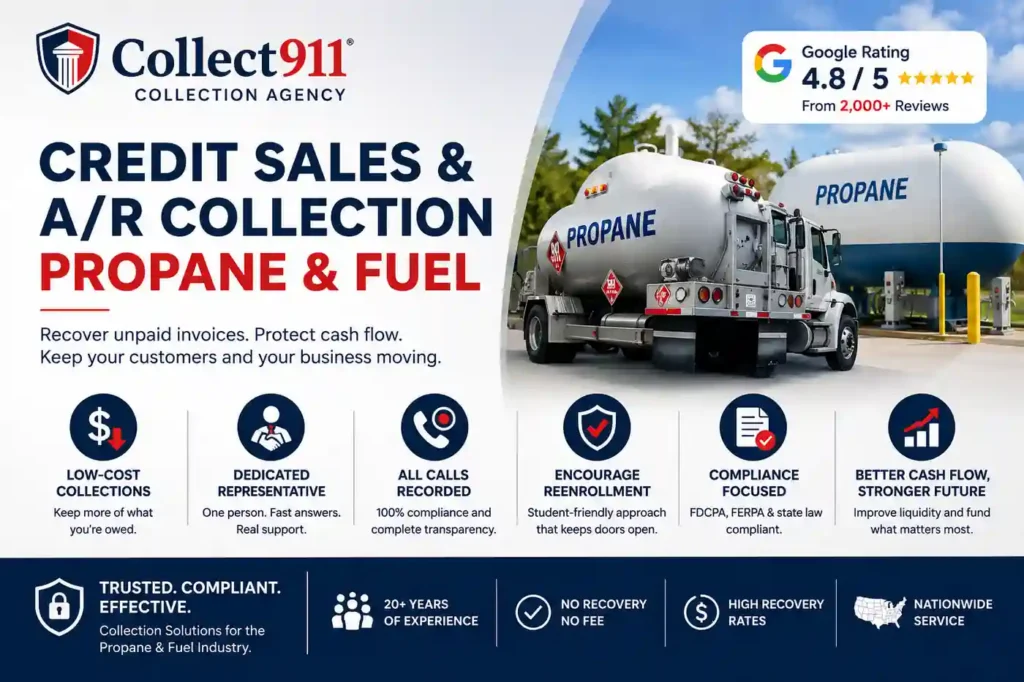
Unpaid fuel invoices shouldn’t freeze your summer cash flow. When seasonal heating bills or fleet accounts drift past 90 days, Collect911 gives fuel distributors a diplomatic, out-of-court way to recover overdue balances—restoring liquid capital while protecting community goodwill.”

Collect911 propane and fuel collection agency helping businesses recover unpaid credit sales and accounts receivable through low-cost, compliant collections and dedicated support.

Unpaid fuel invoices shouldn’t freeze your winter cash flow. In the propane and fuel distribution industry, seasonal demand creates massive ledger surges, and when customers fall behind on will-call deliveries, equipment leases, or budget plans, waiting until summer to collect often means watching your capital evaporate. We built our specialized fuel A/R recovery process around the energy distribution cycle: resolving unpaid commercial fleet and residential heating balances quickly, protecting local community goodwill, and securing out-of-court payoffs before tank recovery or legal escalation becomes necessary.

Quick answer: Collect911 recovers overdue propane, heating oil, and commercial fuel invoices by starting with a flat $15 early-intervention phase for fresh accounts, then moving to contingency, tiered by balance size for commercial and agricultural credit, for older or larger balances, always aiming to get an account resolved before a tank ever has to come back off someone’s property.

Every fuel supplier knows the rhythm: demand spikes hard for a few months, then goes quiet. Accounts receivable follows the same rhythm if you let it, a wave of will-call and budget-plan balances that pile up fast in January and get forgotten by July. The problem is that a balance forgotten in July is a balance that’s much harder to collect by the following winter.

Need a Collection Agency? 

Contact us : Serving Clients Nationwide


The Accounts That Actually Cause Trouble

Not every past-due fuel balance is the same kind of problem.

Will-call vs. automatic delivery.
A will-call customer who’s already behind and calling for another fill mid-cold-snap creates a real tension: refuse and risk a safety complaint, deliver and deepen the exposure. Automatic-delivery customers rarely notice they’re behind until the statement piles up, which usually makes them easier, not harder, to bring current once contacted.

Budget billing defaults. 
Equal monthly payments smooth out the year for the customer, but a mid-year default raises a real question: is the customer on the hook for fuel actually delivered so far, or the full annual estimate? The answer depends entirely on how your specific budget agreement is written, and getting it wrong creates a dispute of its own.

Tank leases and equipment. 
A leased tank sitting on a nonpaying customer’s property isn’t as simple to reclaim as it sounds, more on that below.

Commercial fleet and agricultural credit. 
Larger, more sophisticated buyers, larger balances, and genuinely more leverage available once an account is placed, business credit bureau reporting lands differently on a company that needs financing than it does on a household budget.

What This Costs

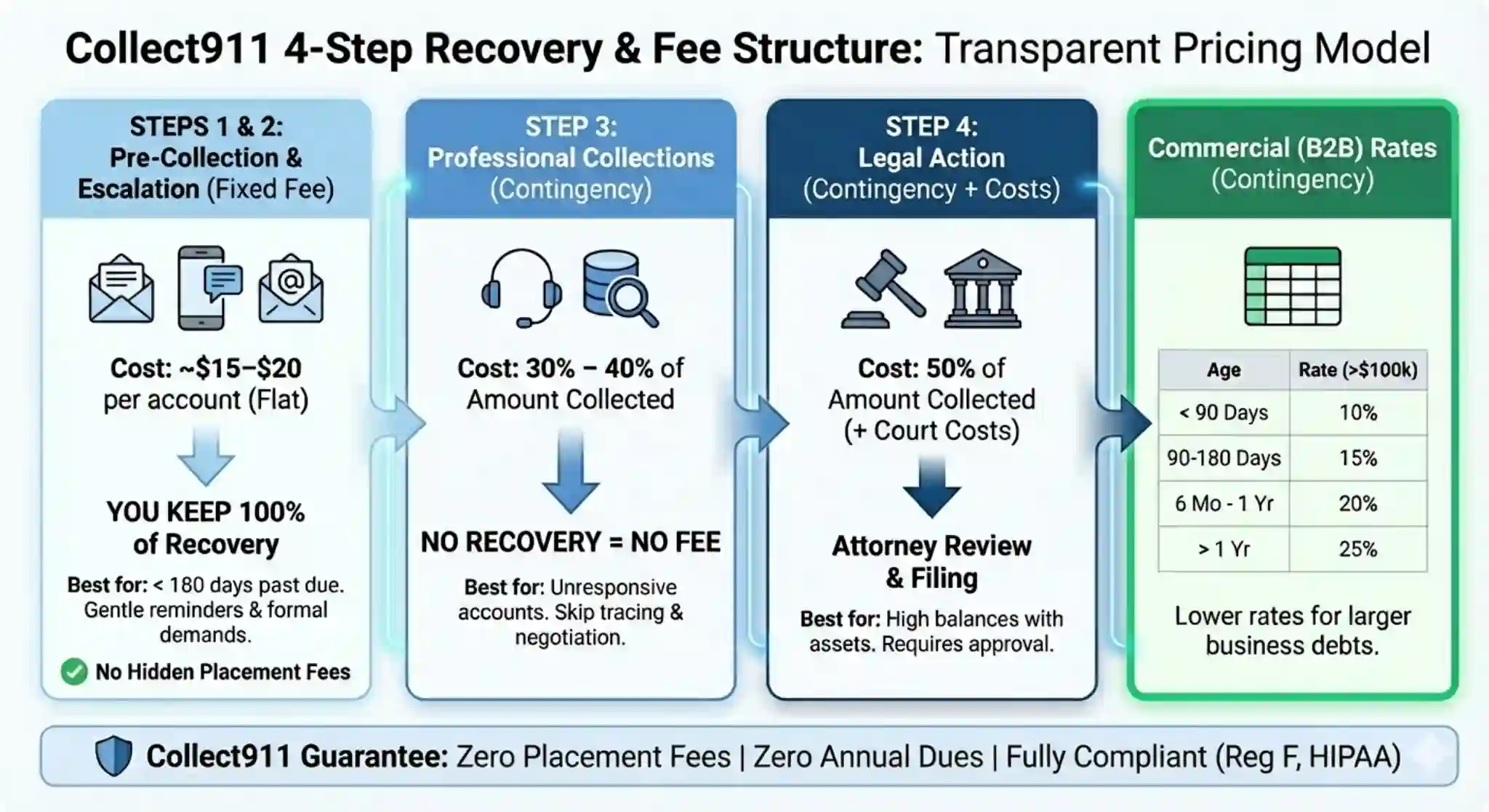
Fixed-Fee Early Intervention: $15 per account, residential or commercial alike. 
A documented letter and call sequence goes out, the customer pays you directly, and you keep every dollar recovered.

Contingency, Residential: 
Once an account is older or unresponsive, contingency rates generally run in the 15% to 40% range depending on age and complexity. No recovery, no fee.

Contingency, Commercial & Agricultural (Tiered):
 Larger commercial fleet and bulk agricultural balances run on a tiered contingency structure rather than one flat percentage, generally scaling down as the balance size goes up. See the full pricing breakdown for the exact tiers.

Out-of-court resolution stays the priority at every stage. Litigation and equipment repossession are expensive, slow, and rarely worth it against what a negotiated payoff or payment plan can accomplish in a fraction of the time.

In-House Fuel Office Collections vs. Collect911 Specialized Fuel Debt Recovery

Factor In-House Collections Collect911 Specialized Recovery
Time Expenditure Office staff juggling calls between dispatch and delivery scheduling Dedicated recovery process, handed off entirely
Skip-Tracing Depth Limited to what a phone number and an old address can tell you Address, asset, and business-ownership tracing built in
Credit Bureau Reporting Leverage Rarely available to an individual fuel supplier Available for eligible accounts; real pressure on repeat commercial buyers
Out-of-Court Settlement Efficiency Ad hoc, dependent on whoever picks up the phone that day Structured negotiation aimed at resolution before litigation

Two Winters, Two Different Recoveries

Result 1: The Regional Propane & Heating Oil Distributor

  • The Situation: A multi-county residential propane supplier had accumulated $78,000 in overdue seasonal heating balances across 52 residential and light-commercial accounts sitting 90 to 180 days past due. With summer approaching, internal office staff were bogged down making unproductive reminder calls instead of preparing for summer tank installations.

  • The Solution: The supplier submitted the accounts to Collect911’s diplomatic recovery pipeline, starting with our $15 fixed-fee early intervention program paired with specialized skip-tracing to verify updated homeownership and employment data.

  • The Result: Within 35 days, Collect911 recovered $54,600 (70%) directly out of court. Over 60% of debtors paid in full or established structured payment schedules prior to the next heating season, preserving valuable customer relationships.

Result 2: The Commercial Fuel & Fleet Lubricant Supplier

  • The Situation: An independent fuel marketer was holding $112,000 in delinquent bulk diesel and fleet card invoices past 120 days from three regional construction and transport companies. The supplier was reluctant to hire expensive legal counsel, which would swallow 33%–40% of their thin operating margins.

  • The Solution: The supplier placed these accounts into Collect911’s Performance Contingency program. Collect911 conducted deep-data corporate asset tracing and applied commercial credit bureau reporting leverage to motivate prompt resolution.

  • The Result: Secured $94,000 (84%) in liquid cash recovery in under 45 days without filing a single court document, restoring vital working capital for new inventory purchases.

Frequently Asked Questions

How does Collect911 handle collections for residential heating oil and propane accounts?

Outreach runs on the industry’s own calendar, not a generic 30/60/90 clock. A homeowner’s ability to pay often genuinely improves once heating season ends and other bills ease up, so early documented reminders start the process, with escalation reserved for accounts that stay unresponsive well past a reasonable window rather than the moment a due date passes.

Can Collect911 collect on unpaid commercial fleet and bulk agricultural fuel invoices?

Yes, and these often move faster than residential accounts, since there’s a business on the other end rather than a household. Larger balances and more sophisticated buyers mean skip-tracing, business credit bureau reporting, and asset checks carry real weight as leverage.

How do you handle customer disputes regarding tank leases or fuel equipment?

Documentation settles most of these quickly. The lease or rental agreement, delivery records, and any maintenance history get reviewed before a dispute is treated as anything other than genuine, since a customer disputing an equipment charge sometimes has a legitimate billing or service complaint worth resolving rather than escalating past.

Do you handle physically recovering a leased propane tank from a nonpaying customer’s property?

Not directly, and it’s worth knowing why before assuming it’s a simple pickup. Even a tank the company legally owns generally can’t be reclaimed without permission or a “breach of peace”, the same limitation that governs auto repossession law. Retrieving company property from someone else’s land usually requires the customer’s cooperation or a proper legal process, not just a truck showing up. Resolving the balance first is almost always faster and lower-risk than a physical retrieval effort.

A customer on a budget billing plan stopped paying mid-year. How is the amount actually owed calculated?

It depends on how the specific budget agreement is written, and that detail matters more than most people expect. Some plans treat the customer as owing only the fuel actually delivered and used to date; others are structured so the equal monthly payment is itself the obligation, meaning a default triggers the full remaining balance of the annual estimate rather than just the fuel already burned. Confirming which version applies happens before pursuing a balance, since collecting the wrong number just creates a new dispute.

A will-call customer who already owes us is asking for another delivery in the middle of a cold snap. Should we deliver?

That’s a business decision more than a collections one, but it’s worth making deliberately rather than by default. Delivering deepens the exposure on an account that’s already not paying; refusing during genuinely dangerous cold risks a safety and reputation problem that costs more than the invoice. A middle path a lot of distributors use is requiring payment, or a partial payment, at the truck before the delivery goes out, which resolves the immediate safety concern without extending more unsecured credit to an account already behind.

What is the fee structure for fuel distributor collections?

Fixed-fee runs a flat $15 per account for early-stage outreach on fresher balances, whether residential or commercial, with the customer paying you directly and you keeping the full recovered amount. Once an account moves to contingency, residential balances generally fall in the 15–40% range depending on age and complexity, while commercial and bulk agricultural accounts run on a tiered structure that scales with balance size rather than one flat rate, see the full pricing page for the specific tiers.

Filed Under: debt

Funeral Homes Unpaid Invoices: Hire a Collection Agency

Funeral Homes collection agency

Your mission is to provide dignity during a community’s most difficult hours, not to act as a high-pressure credit manager. In the funeral industry, the space between professional compassion and financial survival is razor-thin, and every uncollected dollar is a direct hit to your chapel’s ability to sustain its services. We step in as your quiet, professional Account Reconciliation Team, ensuring your reputation for empathy remains protected while your cash flow is restored.

Protecting your business reputation, Collect911 holds licenses in all 50 states, ensuring a safe approach for every debtor interaction. We provide free litigation and bankruptcy scrubs with zero onboarding or annual fees. Our SOC 2 Type II and HIPAA-compliant systems ensure total data security, backed by a 4.85/5 rating from over 2,000 professional reviews. Delivering high recovery rates!

Need a Medical Collection Agency? Contact us


Transparent Recovery for Funeral Directors

 provide clear, ethical pathways to resolve outstanding balances without the friction of onboarding fees:

  • Fixed-Fee Reconciliation ($15): Best for early-stage estate delays or insurance hold-ups. You pay one flat fee per account and your business retains 100% of the recovered funds.

  • Performance-Based Contingency (40%): A “No Recovery, No Fee” model for older, more complex accounts. We only receive a portion if we successfully deliver the check to your office.

Funeral homes have accounts receivables (AR) for several reasons, similar to other businesses providing goods and services. Accounts receivable represent the credit that the funeral home has extended to its clients, meaning services have been provided but payment has not yet been received. This situation can arise from various scenarios:

  1. Insurance Policies: Many clients rely on life insurance policies to cover funeral expenses. The process from claiming the insurance benefit to the actual receipt of funds can take time, during which the funeral service has already been provided. In this case, the funeral home may bill the insurance company directly and await payment, resulting in an accounts receivable.
  2. Pre-arranged Funeral Plans: While pre-arranged or pre-paid funerals are typically paid for in advance, there might be instances where additional services are requested at the time of the funeral that were not covered or anticipated in the original plan. These additional services would then be billed to the family or estate, creating an AR situation.
  3. Government Programs: In some cases, particularly with indigent deaths, the government may cover funeral expenses. Similar to insurance, the payment process can be lengthy, and the funeral home must wait for reimbursement.
  4. Payment Plans: Some funeral homes offer payment plans to families who cannot afford to pay for funeral services upfront. These plans allow for services to be paid over time, but this means the funeral home carries the balance as receivable until fully paid.
  5. Delayed Estate Settlements: When a funeral service is billed to the deceased’s estate, payment can be delayed until the estate is settled. Probate and estate settlement can be a lengthy process, during which the funeral home’s service fees are held as accounts receivable.

How Collection Agencies Help Funeral Homes

  1. Expertise in Collections: Collection agencies specialize in recovering debts that are overdue. They understand the legalities and best practices for contacting individuals and securing payments. Their expertise means they can handle sensitive situations delicately, which is essential in the context of funeral services.
  2. Time and Resource Saving: By outsourcing collections to a specialized agency, funeral homes can save time and resources that would otherwise be spent on following up on overdue accounts. This allows them to focus on their core services and providing support to grieving families.
  3. Improved Cash Flow: Collection agencies can significantly improve a funeral home’s cash flow by recovering unpaid debts. This is crucial for maintaining operations, especially for smaller, independent funeral homes that may not have large financial buffers.
  4. Legal Protection: Collection agencies are knowledgeable about the laws and regulations governing debt collection, including the Fair Debt Collection Practices Act (FDCPA). By hiring a reputable agency, funeral homes can ensure that collection efforts are compliant with legal standards, minimizing the risk of legal repercussions.
  5. Sensitive Communication: Given the nature of their business, funeral homes require a collection process that is respectful and sensitive. Reputable collection agencies are experienced in handling collections tactfully, ensuring that families are approached with empathy and understanding during a difficult time.
  6. Customized Solutions: Some collection agencies offer tailored services to meet the specific needs of funeral homes, including setting up payment plans for families, offering financial counseling, and using diplomatic communication strategies.
  7. Increased Recovery Rates: Professional collection agencies typically have higher success rates in debt recovery compared to in-house efforts, especially for accounts that are significantly overdue. Their techniques and persistence can result in higher recovery rates, directly benefiting the funeral home’s bottom line.

Examples of How Collection Agencies Help Funeral Homes

  • Setting up Payment Plans: An agency might negotiate with a family to establish a reasonable payment plan that fits their financial situation, ensuring the funeral home receives payment over time without causing additional distress to the family. They will also watch out for the estate distribution or insurance reimbursement in case that will cover the expenses.
  • Sensitive Communication: Agencies can use specially trained personnel to communicate with grieving families in a way that is compassionate and understanding, acknowledging their loss while discussing the financial obligations.
  • Legal Action: In cases where payment cannot be secured through normal collection efforts, a collection agency can advise and assist in taking legal action to recover the debt, always ensuring compliance with relevant laws and regulations.
Need a Collection Agency for your Funeral Home? 

Contact us : Serving Clients Nationwide

Filed Under: debt

  • « Go to Previous Page
  • Page 1
  • Page 2
  • Page 3
  • Page 4
  • Page 5
  • Go to Next Page »

Primary Sidebar

Highly Rated Collection agency: 4.85-Star Rating / 2,200+ Reviews
Contact Us:

Need a Collection Agency?
Kindly fill this form.
We’ll get in touch with you


    Please prove you are human by selecting the key.

    • Free Bankruptcy screening.
    • Free Credit Reporting (If law permits).
    • Free Change of Address check
    • Litigious defaulter check.
    • A 5-star rated agency !

    Our aim is to provide all debtors a convenient path towards eliminating their debt in a consumer friendly manner.

    Featured Posts

    • Respectful Medical Collections for Ohio Clinics & Hospitals
    • Credit Unions: Turn Overdue Accounts Into Recovered Revenue
    • Senior Living Collection Agency: Protecting Your Census & Cash Flow
    • Collection Agency for Propane, Fuel and Heating Oil Companies
    • Urgent Care vs Hospitals: Difference with Examples

    Exclusive Posts

    • Top Hospital & Medical Collection Agency in Indiana
    • Top Nevada Collection Agency for Patient Revenue Cycles
    • Idaho Medical Collection Agency: Recover Patient Balances
    • Georgia Medical Collection Agency: Recover Patient Balances
    • Delaware Medical Collection Agency: Recover Patient Balances
    • Colorado Collection Agency: Modern Revenue Cycle Strategies
    • Top Arkansas Collection Agency for Patient Account Solutions
    • Top Arizona Collection Agency for Patient Account Solutions
    • Top Alaska Collection Agency for Patient Account Reconciliation
    • Top Alabama Collection Agency for Unpaid Patient Bills
    • Respectful Medical Collections for Ohio Clinics & Hospitals
    • Medical Collection Agency in Illinois: Recovering Patient Bills
    • Medical Collection Agency in Pennsylvania: Recovering Patient Bills
    • Restoring Texas Medical Vitality: Medical Collection Agency
    • Healthcare Collection Agency: Restoring California’s Medical Vitality
    • Best Collection Agency LA & San Diego: Medical & Business Recovery
    • The 90-Day Deadline: When to Stop Calling and Start Collecting
    • The Bursar’s Guide to Ethical Tuition Recovery | Surviving the Transcript Ban
    • Collection Agency Market Overview
    • Recover Rent Faster: Student Apartment Collection Agency
    COPYRIGHT: COLLECT911 | 2026
    This content is provided for general informational purposes only and should not be considered legal advice. Collection laws and requirements may vary by state, account type, documentation, debtor status, and specific facts. Please consult qualified legal counsel for guidance regarding your particular situation. Collect911 and its authorized collection partners service accounts in accordance with applicable federal and state collection requirements. Visit our home page to know more about us.
    X
    Need a Collection Agency?
    Contact Us