An unpaid eye-care bill is not always a simple patient balance. Was the visit a routine vision exam or a medical eye exam? Did insurance process the claim correctly? Was the refraction or contact-lens fitting excluded from coverage? And is the practice trying to collect for professional care, eyewear, or both?
Collect911 helps optometrists and ophthalmologists sort out valid patient responsibility before collection begins, so an insurance problem does not become a patient dispute. Fresher, well-documented balances can enter our $15 fixed-fee collection program, while older or more difficult accounts can move to contingency collections. The goal is to improve A/R without damaging the patient relationship. Our 4.8-star Google rating reflects our ability to recover funds while maintaining the patient-doctor relationship.
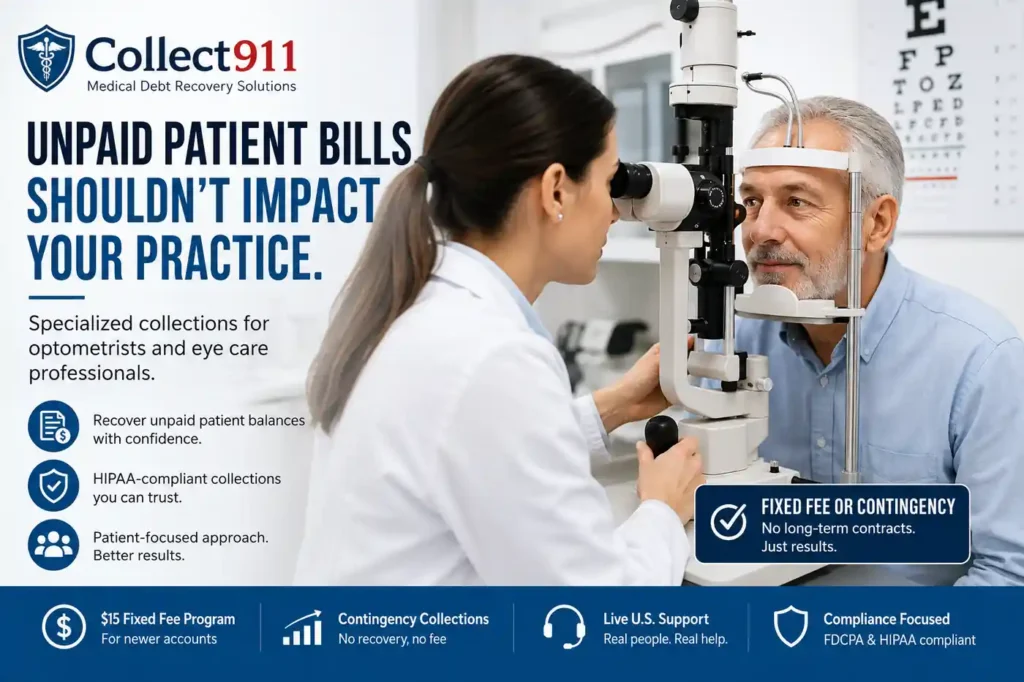
Protecting your reputation, Collect911 holds licenses in all 50 states, ensuring a safe approach for every member interaction. We provide free litigation and bankruptcy scrubs with zero onboarding or annual fees. Our SOC 2 Type II and HIPAA-compliant systems ensure total data security, backed by a 4.85/5 rating from over 2,000 professional reviews. Delivering high recovery rates!
Need a Optometry Collection Agency? Contact us
Our Proven 3-Step Recovery Process
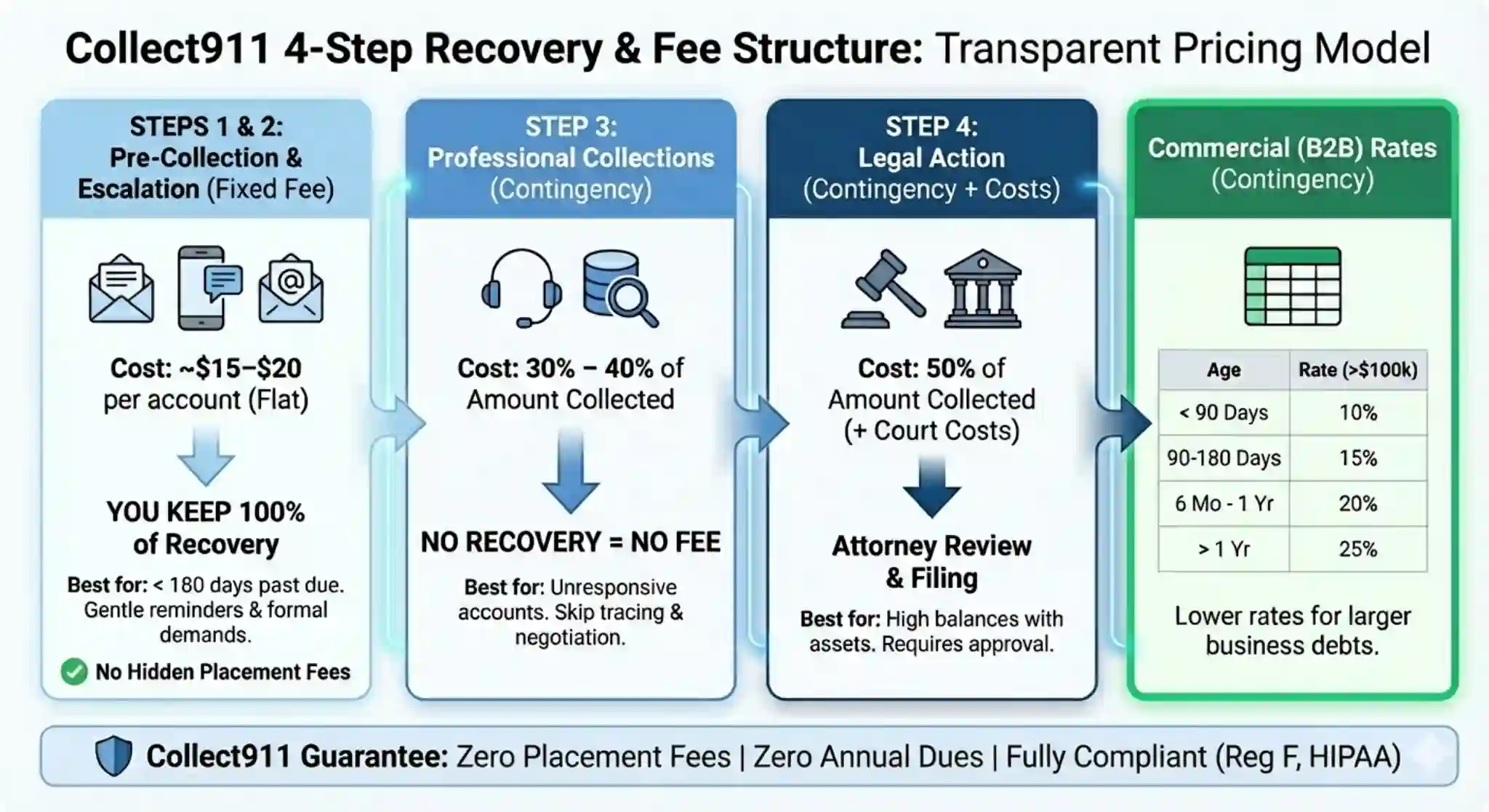
We don’t believe in a “one-size-fits-all” approach. We offer a tiered strategy that allows you to choose the level of intensity based on the age of the debt.
Step 1: The Diplomatic Phase (Fixed-Fee)
This is designed for “good” patients who have simply overlooked a bill. For a low fixed fee (often less than $20 per account), we send a series of professional, third-party demand letters.
-
The Benefit: You keep 100% of the money recovered. Patients pay directly to you.
-
The Goal: To nudge the patient without “burning the bridge.” It signals that your billing office is organized and serious.
Step 2: Intensive Recovery (Contingency)
If the patient ignores the initial letters, the account moves to our intensive recovery phase. This involves skip-tracing, phone contact, and more assertive negotiations. No recovery means No fee.
-
Pricing: 15% to 40% contingency.
-
No Risk: If we don’t collect, you owe us nothing. We only get paid when you do.
Step 3: Final Escalation & Credit Reporting
For the most stubborn accounts, we move to the final tier. Where legally permitted and authorized by you, we report the delinquency to major credit bureaus. This is often the ultimate “trigger” that forces a patient to pay when they attempt to apply for a mortgage or auto loan.
Why Optometrists Trust Collect911
1. Industry-Specific Experience
We understand the difference between a co-pay, a “refraction fee,” and a retail balance for materials. Our team knows how to speak to patients about their vision plans and why they owe the remaining balance.
2. Reputation Protection
In a small community, one “aggressive” collector can lead to a string of 1-star reviews for your practice. We pride ourselves on being firm but professional. We act as an extension of your office, not a “heavy-handed” debt collector.
3. High Recovery Rates
By moving accounts to us early (ideally between 60-90 days), our clients see recovery rates significantly higher than the industry average. We turn your “bad debt” back into liquid cash flow.
4. Verified Transparency
Our 4.8-star rating isn’t just a number—it’s a testament to our transparency. You’ll have access to a portal where you can track every dollar recovered in real-time.

Recent Recoveries
Independent Optometry Practice — Fixed Fee — 72% Recovered
A practice submitted $13,250 in recent deductibles, refraction fees, and patient balances after payer processing was complete.
Recovered: $9,540 — 72% recovery rate
Ophthalmology Group — Contingency — 51% Recovered
An ophthalmology group placed $34,800 in older post-insurance balances after routine billing follow-up had stalled.
Recovered: $17,748 — 51% recovery rate
Multi-Location Eye Care Practice — Fixed Fee + Contingency — 46% Recovered
A multi-location practice referred $25,500 in mixed-age patient A/R. Fresher balances started fixed-fee; difficult older accounts moved to contingency.
Recovered: $11,730 — 46% recovery rate
Frequently Askes Questions
Should an optometrist bill the patient’s vision plan or medical insurance before sending an unpaid balance to collections?
It depends on why the patient was seen and what services were provided. A routine refractive or vision examination is generally handled through the patient’s vision plan, while an examination involving an ocular disease or medical complaint—such as glaucoma, dry eye, infection, cataracts, or diabetic eye disease—may need to be billed to the patient’s medical plan. Before moving a balance to collections, the practice should verify that the appropriate plan was billed, the claim was adjudicated, and the remaining deductible, copay, coinsurance, refraction fee, or non-covered service is genuinely the patient’s responsibility.
Can an optometrist withhold an eyeglass or contact-lens prescription because the patient still owes money?
Federal rules significantly restrict this practice. After a qualifying refractive examination or completed contact-lens fitting, optometrists and ophthalmologists generally must provide the patient with a copy of the prescription without charging an additional prescription-release fee or requiring the patient to purchase eyewear or contact lenses from the practice. A practice may require payment for the examination before releasing the prescription only under limited conditions, including when it routinely requires immediate payment from all comparable examination patients. An old unpaid balance should therefore be pursued through the billing and collection process rather than by improperly withholding a prescription.
What if a patient says their vision insurance should have paid an optometry bill that is now overdue?
Review the claim before treating the amount as bad debt. Vision plans and medical plans can cover different parts of an eye-care encounter, and coordination of benefits can be particularly complicated in optometry. For example, a medical eye examination may be billed to medical insurance first while an eligible vision benefit may later help with certain uncovered portions, depending on the plan. The practice should review the EOB, payer contract, claim status, coordination-of-benefits requirements, and the patient’s true responsibility before referring the balance for collection.
Can a self-pay eye-care patient dispute a bill that is much higher than the estimate?
Yes, in qualifying cases. Under the federal Good Faith Estimate rules, uninsured patients and patients who choose not to use insurance generally must receive an estimate for scheduled healthcare services. If a provider’s final bill is at least $400 more than that provider’s Good Faith Estimate, the patient may qualify for the federal Patient-Provider Dispute Resolution process if the other requirements are met. While a qualifying dispute is pending, the disputed bill cannot be moved into collections, and existing collection activity on that disputed amount must stop.
Does an optometry practice need to send the patient’s entire eye chart or retinal images to a collection agency?
Usually not. HIPAA permits healthcare providers to use collection agencies as part of their payment activities, but the minimum necessary rule generally requires the practice and its business associate to limit protected health information to what is reasonably necessary for collection. A typical collection file may need identifying information, the amount owed, dates of service, billing records, insurance disposition, and supporting documentation—but that does not mean the collector automatically needs the patient’s complete clinical record, retinal images, or unrelated diagnoses.
Can a collection agency contact a parent or guarantor about a child’s unpaid eye-care bill?
Yes, when appropriate for obtaining payment, but the practice should first confirm who is actually financially responsible for the account. HIPAA allows a healthcare provider or its business associate, including a collection agency, to communicate with another person as reasonably necessary to obtain payment for healthcare. Any disclosure must still be limited appropriately, and applicable confidential-communication requests and other legal restrictions must be respected. Accurate guarantor information is therefore especially important before pediatric optometry balances are transferred for collection.
Stop Letting Your Profits Walk Out the Door. Don’t let “one more month” of promises turn into a total loss. Whether you need a low-cost letter service or an assertive recovery team, we have the tools to secure your practice’s financial future.