Late invoices aren’t just annoying. They silently drain cash, focus, and confidence.
When a client tells you, “I just need one more month,” they aren’t asking for a favor, they are asking for an interest-free loan.
Every time you say yes to a delay, the value of that invoice drops. In the debt collection industry, time is the enemy of money. Here is the reality of what happens when you wait.
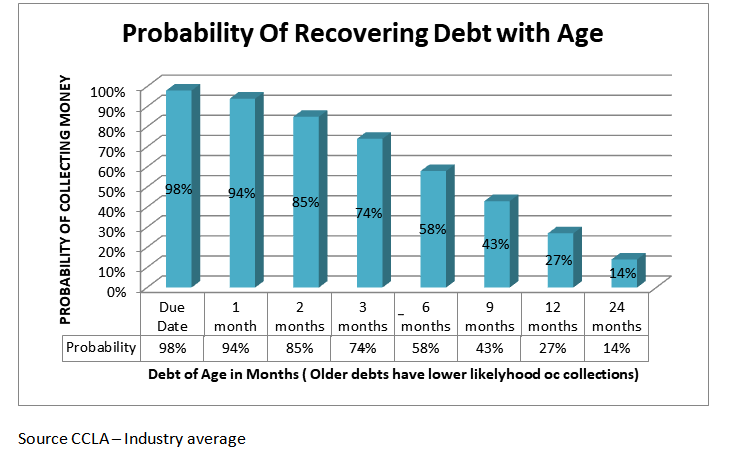
Quick answer: Most invoices should move from internal follow-up to a collection agency by 90 days past due. Industry data shows recovery probability has already fallen from roughly 94% at 30 days to around 74% by 90 days, and it keeps dropping every month after that. Waiting past 90 days rarely buys goodwill; it mostly buys a smaller eventual recovery.
The Real Cost of Waiting
Recovery Probability by Invoice Age
Data commonly attributed to the Commercial Law League of America (exact figures vary slightly by source and survey year, but the pattern is consistent) shows collectability declining sharply, and non-linearly, the longer an invoice ages:
| Invoice Age | Estimated Recovery Probability |
|---|---|
| 30 days past due | ~94% |
| 90 days past due | ~74% |
| 6 months (180 days) | ~58% |
| 1 year past due | ~27% |
The curve bends hardest in the first 90 days, which is exactly the window most businesses spend hoping the client “just needs a little more time.” By the time an account is a year old, roughly three out of every four dollars originally owed are gone for good.
By “being nice” and waiting another 30 days, you aren’t being a good partner; you are taking a real haircut on money you’ve already earned.
Why “Being Patient” Isn’t a Strategy
Most small to mid-sized businesses operate on thin margins. When you allow a customer to hold onto your cash, you are financing their business growth with your payroll and operating capital. Professional creditors know that the squeaky wheel gets paid first. If you aren’t creating a sense of urgency, your invoice stays at the bottom of their pile.
Recognizing Stall Tactics
A debtor who genuinely intends to pay will usually offer a partial payment or a specific date. A debtor who is in trouble will give you vague promises:
- “The check is in the mail.”
- “We’re waiting on a big contract to close.”
- “Our accounting person is out this week.”
- “We’re disputing part of the invoice” — raised for the first time only after a payment reminder, with no specifics.
These are classic stall tactics designed to keep you quiet while they pay more aggressive creditors first.
When It’s Time to Stop Calling Yourself
Many business owners hesitate to use a collection agency because they fear “ruining the relationship.”
The truth: If a client hasn’t paid you in 90 days and refuses to communicate, the relationship is already broken. Moving the account to a professional third party like Collect911 removes the emotion from the transaction and signals that your terms are serious.
A Note on Compliant Internal Collections
Even before an account reaches a professional agency, how you collect matters. Many states extend debt-collection-style communication rules, restrictions on contact frequency, prohibitions on misleading statements, required language in written notices, to original creditors collecting their own accounts, not just outside agencies. For medical practices, that sits alongside HIPAA: billing communications about a specific patient balance still need to be handled with the same care given to any other protected health information. None of this means you can’t call a client directly; it means those calls are worth treating as seriously as the ones a professional agency would make.
Final Notice Template (Before You Escalate)
| Final Notice: Formal Demand for Payment Subject: FINAL NOTICE: Outstanding Balance for [Your Business Name] – [Invoice #] Dear [Debtor Name/Accounts Payable Team], We value our professional relationship and have made every effort to be patient. However, we can no longer maintain this balance as an open account. This is your final notice. Please be advised of the following: Next Steps: If payment is not confirmed by the deadline, your account may be formally closed and transferred to a professional collection agency, our third-party debt recovery partner, for immediate action. Consequences of Transfer: Once transferred, this matter may affect your commercial credit profile and may include additional collection costs or interest as permitted by law. How to resolve this now: Please [Insert Payment Link/Instructions] or call us at [Your Phone Number] to confirm your wire transfer. If you have already sent payment, please provide the transaction details immediately so we can halt the transfer process. [Your Name/Company Name] [Phone Number] [Website] |
A Real-Life Scenario
A small equipment supplier had a client stall for four months with a rotating set of excuses, “the check is coming,” then “our AP person changed,” then silence. By the time the account was finally assigned at the five-month mark, the invoice was already worth roughly half what it would have been at 90 days. The business owner’s own estimate was that the three extra months of “being patient” cost more than the eventual collection fee would have, a pattern that shows up often enough that it’s worth treating as the rule rather than the exception.
The Collect911 Advantage
We don’t use “debt collector” scripts that burn bridges. We use a professional, compliant, and firm approach to get you paid.
- Low Risk: We work on a contingency basis, generally 15% to 40% depending on account age and type. If we don’t recover your money, you owe us nothing on that account.
- Track Record: We maintain a 4.8-star Google rating, aiming to balance strong recovery rates with professional communication.
- Speed: Our process is built to trigger prompt action, aiming to move your invoice up the debtor’s priority list rather than letting it sit.
The Bottom Line: Don’t let another 30 days of “promises” turn into a total loss.
Frequently Asked Questions
How long should a business wait before sending an unpaid invoice to collections?
Around 90 days is the general benchmark. Recovery probability is still relatively strong before that point, but it declines meaningfully afterward, so 90 days functions as the practical line between “still worth pursuing yourself” and “worth handing to a professional agency.”
What are the primary warning signs that a client is using stall tactics?
Vague, non-specific promises rather than a concrete date or partial payment: “the check is in the mail,” a sudden staffing excuse, or a dispute raised for the first time only after a reminder is sent, with no supporting detail. A debtor who genuinely intends to pay usually offers something concrete instead.
Does sending a “Final Notice” letter myself count as debt collection activity I need to worry about compliance for?
It can, depending on your state and the nature of the debt. Even original creditors collecting their own accounts are sometimes subject to state-level rules on communication frequency, required disclosures, and prohibited statements, not just third-party agencies. It’s worth keeping any internal collection correspondence factual and professional for that reason alone.
If I send the account to collections at 90 days, do I lose the ability to negotiate directly with the client myself?
No, not typically. You generally still make the final call on settlements, payment plans, or pulling an account back, a professional agency works the account on your behalf, but major decisions usually still route through you unless you’ve agreed otherwise.
Does the 90-day rule apply the same way to patient medical bills as it does to commercial B2B invoices?
Not exactly, though the same don’t-wait-too-long principle applies. Patient balances often involve an extra step before the 90-day clock should even start counting down: insurance processing, EOB reconciliation, and, for many providers, a documented financial-assistance or charity-care screening. Once that groundwork is done and a balance is confirmed as the patient’s responsibility, the same aging math applies, waiting doesn’t make a patient more likely to pay, it just gives the balance more time to quietly become uncollectible.