An unpaid tuition bill shouldn’t mean a permanently burnt bridge. In higher education, the ultimate recovery isn’t just balancing the ledger, it’s clearing the path for a student to re-enroll and finish their degree. We built our nationwide tuition recovery process around student-friendly mediation: protecting your institution’s 5-star reputation, handling every account with a dedicated client specialist, and converting delinquent tuition into renewed enrollment, all without the high costs or hostility of traditional collections.
Quick answer: Collect911 recovers past-due tuition through student-friendly, out-of-court mediation, starting with a $15 fixed-fee early-intervention phase and moving to a 40% contingency model only for aged or unresponsive accounts, all FERPA-compliant and built around getting students back into re-enrollment rather than simply writing off the balance.
If you are a Chief Business Officer or Bursar, you don’t need a spreadsheet to tell you that this is a fiscal tightrope. You are squeezed between two massive pressures:
- The Enrollment Cliff: The long-predicted demographic drop in traditional college-aged students is here. Every single enrollee is now a precious resource you cannot afford to lose.
- The End of Leverage: Your most effective tool for recovering unpaid tuition, the transcript hold, is being dismantled. Between the Department of Education’s administrative capability rules (34 CFR 668.14) and state-level bans in New York, California, and beyond, using transcripts to compel payment is becoming a legal liability.
At the same time, tuition discounting has hit a record high of 56.3% for first-time undergraduates. This leaves you with razor-thin margins. When a student defaults on that remaining revenue, it’s not just a “bad debt expense,” it’s a threat to your operational stability.
The old “dial-and-demand” collection model is dead. It alienates students and invites regulatory scrutiny. Here is how we help colleges recover revenue while protecting their reputation and enrollment numbers.
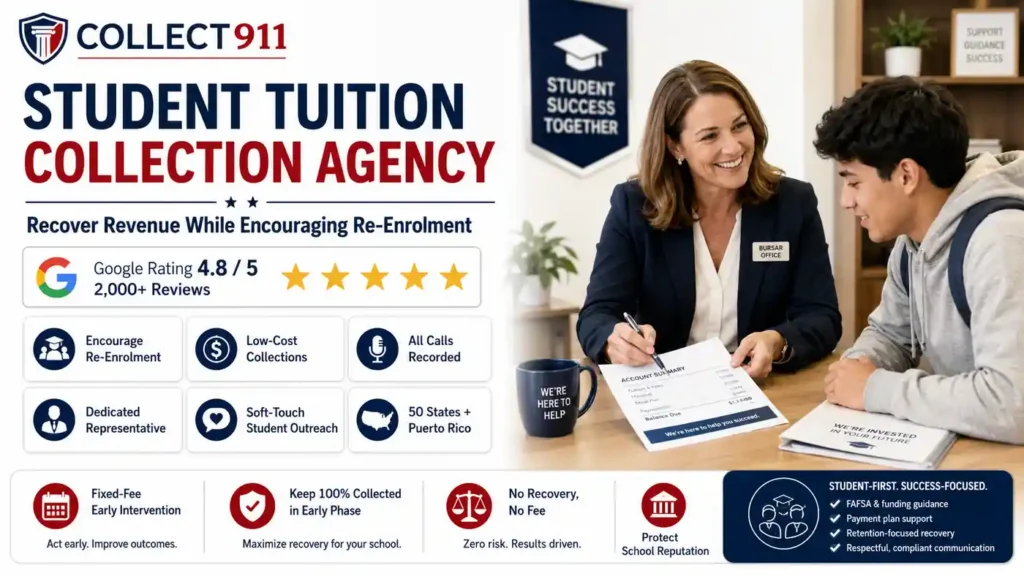
Protecting your college reputation, Collect911 holds licenses in all 50 states, ensuring a safe approach for every patient interaction. We provide free litigation and bankruptcy scrubs with zero onboarding or annual fees. Our SOC 2 Type II and FERPA-compliant systems ensure total data security, backed by a 4.85/5 rating from over 2,000 professional reviews. Delivering high recovery rates!
Need a Education Collection Agency? Contact us
The New Goal: Collection Through Re-Enrollment
Traditional agencies view a past-due student balance as a debt to be liquidated. We view it as a retention opportunity.
When a student drops out with a balance (often triggering a “Return to Title IV” liability for the institution), everyone loses. The student has debt but no degree; the institution has a write-off and a vacant seat.
Our recovery strategy focuses on getting the student back into the classroom.
- The FAFSA Solution: Many students stop paying because they lost funding or missed a deadline. Our agents act as financial literacy concierges, encouraging students to complete their FAFSA and access government grants.
- Unlocking Funds: If we can help a student resolve enough of their balance to re-register, they can often access new Pell Grants or loans. This works for the institution because these funds can effectively clear the old institutional debt over time, ensuring payment while the student completes the program they started.
Pricing: Two Flexible Recovery Paths
| Path | Best For | Cost | You Keep |
|---|---|---|---|
| Fixed-Fee Early Intervention | Accounts 30–90 days past due | ~$15 per account (five contacts) | 100% of what’s recovered |
| Contingency Resolution | Non-responders or accounts 120+ days delinquent | 40% contingency | Everything above the fee — No Recovery, No Fee |

See our full pricing breakdown for details across account types.
A Strategic Workflow for the Regulatory Landscape
We operate across all 50 states and Puerto Rico, managing the complex compliance matrix of state-specific laws so you don’t have to. Most clients see the best results by moving accounts from their internal billing into our two-tiered external workflow:
Fixed-Fee Early Intervention (The “Retention” Phase)
Best for accounts 30–90 days past due. A series of diplomatic, soft-touch letters and digital reminders goes out on our third-party letterhead. The tone is helpful, not accusatory. This “nudge” effectively separates students who just forgot to pay from those with serious financial barriers, often clearing 30–40% of the queue for pennies on the dollar.
Contingency Collections (The “Resolution” Phase)
For accounts that haven’t responded to early intervention, or older delinquencies (120+ days). We deploy intensive skip-tracing to locate former students who have moved, a common issue with dropouts, and use negotiation techniques to secure voluntary repayment plans. No Recovery, No Fee, incentives stay aligned with yours.
Need a Collection Agency? Contact us
Why Colleges Are Switching to Us
We are not just a vendor; we are a partner in your revenue cycle.
- Compliance as a Service: We understand the nuance of the current “paid-for” transcript regulations, and help you navigate partial transcript releases so you remain compliant with federal law without giving up all your leverage.
- Reputation Management: Check our Google reviews. We treat students with dignity. In the age of social media, a heavy-handed collector can cause a PR nightmare. We protect your alumni relationships.
- National Reach: Whether a former student moved to a strict regulatory state like Massachusetts or a garnishment-friendly state, we know the local laws and how to recover funds legally.
- A Dedicated Account Manager: Every institution is assigned a single, dedicated representative for seamless bursar and financial aid office coordination, not a rotating cast routed through a general queue.
Standard Agencies vs. Collect911 Student-Friendly Recovery
| Factor | Standard Collection Agencies | Collect911 Student-Friendly Recovery |
|---|---|---|
| Reputation Protection | Often generic “dial and demand” scripts, risking public complaints | Empathetic, diplomatic outreach built around institutional reputation |
| FERPA Compliance | Varies; not always built specifically around education-record standards | FERPA, FDCPA, and FCRA compliance built into every account from intake |
| Re-Enrollment Focus | Treats the balance as debt to liquidate, full stop | Treats resolution as a path back to re-enrollment where realistic |
| Dedicated Representative Access | Often routed through a general call queue | Single dedicated account manager per institution |
| Out-of-Court Settlement Priority | Litigation-first posture on aged accounts | Negotiated resolution prioritized; legal action reserved as last resort |
Recent Recovery Results
Career & Technical College
An $86,000 tuition balance across multiple stalled accounts moved through our two-tiered recovery process. $57,600 was recovered, and 11 students used the resolution process to clear enough of their balance to re-enroll and continue their programs, turning a write-off into both recovered revenue and retained enrollment.
Private Liberal Arts University
$135,000 in charged-off tuition, spread across former students nationwide, was placed into our contingency program. $98,500 was recovered out of court, without litigation costs or the reputational risk of an aggressive collection posture.
Frequently Asked Questions
How does Collect911 protect our institution’s reputation while collecting past-due tuition?
Every account is handled with empathetic, diplomatic outreach rather than aggressive dial-and-demand tactics, and our own reputation is a matter of public record, worth checking our Google reviews directly. Protecting your institution’s reputation is treated as part of the recovery strategy, not a separate concern layered on top of it.
Can Collect911’s tuition recovery process actually help stop-out students re-enroll?
That’s the explicit goal, not a side benefit. Many students who stop paying have lost financial aid eligibility or missed a FAFSA deadline rather than simply refusing to pay, and our outreach is built to identify that distinction and point students toward resolving it. When a student can access new aid to clear enough of an old balance to re-register, the institution recovers the debt and keeps the student.
Is Collect911 fully FERPA-compliant when handling student financial records?
Yes. Every account is handled under FERPA’s requirements for student education records, alongside FDCPA and FCRA standards governing communication and credit reporting.
Will our institution have a dedicated account manager for bursar office coordination?
Yes. Every institution is assigned a single, dedicated representative rather than routed through a general call queue, specifically so bursar and financial aid office coordination doesn’t require re-explaining your institution’s policies to a different person every time.
What is the fee structure for educational accounts?
A fixed fee of roughly $15 per account covers early intervention (accounts 30–90 days past due), with the institution keeping 100% of anything recovered. Accounts that don’t respond, or that are already 120+ days delinquent, move to a 40% contingency model, no recovery, no fee.
A veteran student’s GI Bill benefits haven’t been disbursed yet, and their account shows as delinquent in the meantime. Should this be treated the same as an ordinary past-due balance?
No, and treating it that way risks a genuinely unfair outcome. VA disbursement delays are common and outside the student’s control, so an account that’s delinquent only because of a pending Post-9/11 GI Bill payment needs a different first move: confirming the certification and expected VA payment timeline before any collection outreach begins, not after. These accounts get flagged separately rather than run through the standard cadence.
If a student’s balance came from a Return to Title IV recalculation after they withdrew, is that debt collectible the same way as an ordinary tuition balance?
Generally yes, once it’s actually confirmed as owed, but it’s worth double-checking the R2T4 math before pursuing it aggressively. A Return to Title IV recalculation can leave a student owing an institutional balance that didn’t exist before their withdrawal, and errors in that calculation aren’t uncommon. These accounts are treated as legitimate debt once verified, but a student disputing the R2T4 math itself deserves a real look, not a form-letter response.
A former student defaulted and then left the country. Is there any realistic way to collect?
It’s genuinely harder, and worth setting expectations accordingly. Domestic skip-tracing, credit bureau reporting, and most legal remedies assume a U.S. address and credit history, none of which apply once a student has returned home. The more realistic levers become institutional rather than financial: whether a diploma or transcript request can be conditioned on the balance where legally permitted, or whether the student would need a clean account to apply to a different U.S. institution later.
The page mentions “partial transcript releases.” What does that actually mean in practice?
It’s a middle ground between withholding a transcript entirely, increasingly restricted or banned outright in a growing number of states, and releasing it with no leverage at all. In practice, this usually means releasing an official transcript for a specific, legitimate purpose, transferring credits, applying for a job, while still declining to issue things like a diploma or a fully “resolved” academic record until the balance is addressed. The exact line depends on the specific state’s transcript law, so this gets evaluated institution by institution rather than applied as a blanket rule.
The enrollment cliff means you cannot afford to lose students, and the regulatory shifts mean you cannot afford to be non-compliant. Let’s modernize your receivables strategy to recover more tuition, retain more students, and stabilize your balance sheet.