• Skip to main content
  • Skip to primary sidebar

Collect911

  • Home
  • Pricing
  • Contact Us

debt

Medical Collection Agency in Pennsylvania: Recovering Patient Bills

Restoring Pennsylvania’s Medical Financial Vitality

In Pennsylvania’s premier medical hubs—from the advanced surgical centers of Pittsburgh’s “Golden Triangle” to the high-volume clinical corridors of Philadelphia’s University City—stagnant patient balances represent a critical bottleneck to care. We provide specialized revenue recovery for PA providers navigating the staff burnout and rising deductibles of the Current healthcare landscape. Our core philosophy is the Urgent, Effective, and Respectful recovery of patient bills, ensuring your practice remains financially healthy without compromising the provider-patient relationship.

Protecting your practice’s reputation, Collect911 holds licenses in all 50 states, ensuring a safe approach for every patient interaction. We provide free litigation and bankruptcy scrubs with zero onboarding or annual fees. Our SOC 2 Type II and HIPAA-compliant systems ensure total data security, backed by a 4.85/5 rating from over 2,000 professional reviews. Delivering high recovery rates!

Need a Medical Collection Agency? Contact us

Surgical Precision in Pricing: The $15 Fixed-Fee vs. Contingency

We empower Pennsylvania’s medical elite with two distinct, high-ROI paths to recovery, engineered for the specific margins of modern practice management:

  • Fixed-Fee Reconciliation ($15): The “Soft Nudge” for accounts 60–180 days past due.

  • For a flat $15 per account, we deploy a professional demand phase where the patient pays you directly and you retain 100% of the recovered funds.

  • Performance Contingency (40%): Our “No Recovery, No Fee” model for aged or complex balances.

  • We assume the full risk and cost of deep-data skip-tracing and professional mediation.

  • If we don’t bring your capital home, you don’t pay a cent.

The CPA Edge: Neutralizing Your Recovery Costs

Beyond the immediate cash flow injection, our $15 fixed-fee model offers a unique structural advantage. In many clinical business models, this fee can be neutralized as a tax-deductible business expense, effectively lowering the net cost of your recovery efforts. By treating account reconciliation as a professional service rather than a loss, you optimize your year-end tax position while simultaneously cleaning up your A/R.

The Clinical Philosophy: Bridging the Responsibility Gap

The “Patient-Responsibility Gap” is the most significant fracture in the modern revenue cycle. As deductibles climb, patients often feel overwhelmed by billing “static” rather than an unwillingness to pay.

The “Peace of Office” Benefit

By outsourcing the friction of collections, you restore the “Peace of Office.” Your front-desk staff can return to their primary mission: patient care and clinical coordination. Outsourcing reduces the burnout associated with aggressive financial conversations, allowing your team to remain the “friendly face” of the practice while we handle the Urgent, Effective, and Respectful reconciliation of the balance.

The “Respectful Friction” Model

We don’t demand; we reconcile. Our team acts as Account Reconciliation Concierges, helping patients navigate billing confusion to find a path to payment. This approach protects your 5-star reputation on platforms like Google and Healthgrades while maintaining strict HIPAA compliance.

Bilingual Inclusivity

To ensure no patient is left behind by a language barrier, we utilize Spanish-speaking specialists. This inclusivity leads to faster resolutions and ensures your practice serves the diverse demographics of Pennsylvania with dignity and clarity.

Recent Clinical Recovery Results

The Case: A Specialist Fertility Clinic in Allentown

  • The Case: Unpaid self-pay balances for IVF cycles.

  • The Respectful Intervention: Our concierges identified that many patients were simply confused by their EOB (Explanation of Benefits) vs. the clinic’s final invoice.

  • The Financial Result: We secured $14,400 in recovery within 45 days, maintaining 100% patient loyalty by clearing the “administrative static”.

The Case: A Dental/Orthodontic Practice near Philadelphia

  • The Case: Delinquent installment payments for orthodontic bracing.

  • The Respectful Intervention: We utilized our sophisticated reconciliation approach, setting up manageable payment plans that respected the patient’s long-term relationship with the doctor.

  • The Financial Result: The practice recovered $9,850 in past-due balances while ensuring the treatment plans continued without interruption.

The Security Suite: Protecting Your Reputation

We go beyond the phone call to ensure every account is handled with surgical accuracy:

  • The Patient Scrub: We perform a comprehensive litigation check, bankruptcy check, USPS address verification, and deep-data skip tracing before any outreach begins.

  • Quality Control: To prevent “rogue collectors” and protect against “review-bombing,” calls are recorded and randomly reviewed.

  • Modern Channels: We utilize secure, HIPAA-compliant email and text messaging to meet patients where they are, leading to faster response times and higher satisfaction.

Areas of Expertise

  • Healthcare & Medical (Hospitals/Clinics)

  • Dental (General/Orthodontics)

  • Senior Living (Assisted/Skilled Nursing)

  • Fertility Clinics

  • Cosmetic Surgery

The Pennsylvania Regulatory Landscape & Federal Compliance

Recovering medical revenue in the Commonwealth requires adherence to the Pennsylvania Fair Credit Extension Uniformity Act (FCEUA), which regulates both original creditors and third-party collectors.

Credit Reporting Hurdles

Credit reporting on medical debts has become significantly more difficult due to evolving federal and state-level protections. New directives are moving to eliminate many medical debts from credit reports entirely, making mediation-first recovery vital, as the “threat” of a credit score impact is no longer a viable lever for many balances.

Federal Mandates

Under Current guidelines, providers must also navigate the federal No Surprises Act, designed to protect patients from unexpected out-of-network bills in emergency and certain non-emergency settings.

Rule Type Current Requirement
Statute of Limitations Generally 4 years for medical debt in Pennsylvania from the date of last payment.
Wage Garnishment Highly restricted; generally not permitted for civil debts like medical bills in PA.
No Surprises Act Prohibits “balance billing” for emergency out-of-network care and requires a Good Faith Estimate (GFE).
Interest Caps Under recent Pennsylvania legislative initiatives, medical debt interest may be capped at 6%.

Healthcare-Focused FAQ

1. How do you handle a patient dispute without losing their loyalty?

Disputes are often just requests for clarity. Our concierges act as mediators, reviewing the ledger alongside the patient. By resolving the “administrative static” first, we find that most patients are willing to settle the account once they feel heard and understood.

2. How does the No Surprises Act affect our internal billing?

Providers are now required to provide a Good Faith Estimate to self-pay patients at least 1 to 3 business days before scheduled care. If the final bill exceeds this estimate by $400 or more, the patient may trigger a federal dispute resolution process.

3. Is this process truly HIPAA compliant?

Yes. From our secure data encryption to our staff training, every touchpoint is engineered to exceed federal HIPAA and HITECH standards. Your patient data is guarded as fiercely as your reputation.

Get a Free Pennsylvania Recovery Quote
No setup fees. No long-term contracts. Just results.

Filed Under: debt

Restoring Texas Medical Vitality: Medical Collection Agency

In the high-stakes healthcare landscape of Texas—from the world-renowned Texas Medical Center in Houston to the rapidly expanding medical hubs of Dallas and Austin—providers are facing a quiet crisis of unpaid balances. As systems like Baylor Scott & White and Memorial Hermann consolidate, independent clinics and specialty practices are left to bridge a growing “Patient-Responsibility Gap” created by high-deductible plans. These financial leaks don’t just hurt your bottom line; they drain staff morale and compromise the administrative health of your entire practice.

Protecting your practice’s reputation, Collect911 holds licenses in all 50 states, ensuring a safe approach for every patient interaction. We provide free litigation and bankruptcy scrubs with zero onboarding or annual fees. Our SOC 2 Type II and HIPAA-compliant systems ensure total data security, backed by a 4.85/5 rating from over 2,000 professional reviews. Delivering high recovery rates!

Need a Medical Collection Agency? Contact us


Revenue Recovery Pricing Designed for Texas Scale

We believe in transparent, results-driven partnerships that prioritize your cash flow without the typical overhead of a traditional collection agency. Our Current fee structures are built for speed:

  • The $15 Fixed-Fee Solution: You retain 100% of the recovered balance. This is the ultimate “Account Reconciliation” tool for early-stage accounts that simply need a professional nudge.

  • The 40% Contingency Model: For older or more complex balances, we work on a performance basis. If there is no recovery, there is no fee.

The CPA Edge:
A Net-Zero Cost Strategy
Many of our Texas partners find that the $15 fixed-fee service essentially pays for itself. In the Current tax environment, these fees are commonly categorized as a deductible business expense when used in the normal course of revenue cycle management. After a quick consultation with your CPA, you may find that professional recovery becomes a tax-neutral investment in your practice’s stability.


The Clinical Philosophy of Account Reconciliation

The Patient-Responsibility Gap

Modern billing is no longer just about insurance processing; it is about managing the “Patient-Responsibility Gap.” With the rise of high-deductible health plans (HDHPs) across the Lone Star State, patients are often hit with unexpected costs that they aren’t prepared to pay. These balances aren’t usually a sign of refusal, but of confusion. We step in as an extension of your office to provide the clarity needed to resolve these accounts.

Peace of Office: Defeating Staff Burnout

When your front desk staff is forced to double as a collection department, productivity and morale plummet. Your team was hired for clinical empathy, not to manage financial friction. Outsourcing these uncomfortable conversations to our Account Reconciliation Team allows your staff to return to their core work, significantly reducing burnout and improving the patient experience in the waiting room.

The Respectful Friction Model

We protect your hard-earned 5-star reputation on Google and Healthgrades through “Respectful Friction.” By working with patients to find solutions rather than arguing against them, we secure payments while keeping the patient-provider relationship intact. This diplomatic approach ensures full HIPAA compliance and prevents the “review-bombing” that can occur with aggressive tactics.

Bilingual Outreach for a Diverse Texas

Texas is a multicultural powerhouse, and communication is key to recovery. Our Spanish-speaking collectors provide an inclusive experience that removes linguistic barriers, leading to faster resolutions and higher satisfaction for your entire patient population.


Recent Clinical Recovery Results

Result 1: Cosmetic Surgery Specialist – Dallas, TX

A prominent cosmetic surgery practice in Dallas was struggling with post-procedure balances that were lingering past 90 days.

  • The Case: High-value elective accounts were falling into “silent drift” as patients avoided the front desk’s follow-up calls.

  • The Respectful Intervention: We employed secure, HIPAA-compliant email and text outreach to offer discrete payment pathways.

  • The Financial Result: We recovered $24,500 within 60 days, maintaining the practice’s elite reputation in the DFW regional healthcare hub.

Result 2: Family Dental & Orthodontic Practice – San Antonio, TX

A high-volume orthodontic clinic near the South Texas Medical Center found its cash flow hampered by incomplete payment plans.

  • The Challenge: Long-term treatment plans were being abandoned financially mid-cycle.

  • The Respectful Intervention: Our team performed a full “Patient Scrub” and initiated a bilingual outreach campaign.

  • The Financial Result: By reconciling the accounts with empathy, we recovered $12,800 and successfully returned several patients to their active treatment schedules.


The Security Suite: Clinical-Grade Protection

We treat your data with the same level of care you provide your patients. Our Current “Patient Scrub” includes:

  • Comprehensive Screening: Litigation checks, bankruptcy scrubs, and USPS address verification to ensure we contact the right person at the right time.

  • Skip Tracing: Utilizing advanced tools to locate patients who have moved without updating their records.

  • Quality Control: Every call is recorded and reviewed to prevent “rogue collectors” and ensure every interaction meets our respectful standards.

  • Modern Channels: We offer secure, HIPAA-compliant email and text options for faster response times.


Targeted Areas of Expertise

  • Healthcare & Medical (Hospitals/Clinics)

  • Dental (General/Orthodontics)

  • Senior Living (Assisted/Skilled Nursing)

  • Fertility Clinics

  • Cosmetic Surgery


Regulatory Landscape & The No Surprises Act

Navigating recovery in Texas requires strict adherence to both federal and state mandates. We ensure 100% compliance with the Texas Debt Collection Act (TDCA) and federal FDCPA/HIPAA privacy rules. Crucially, our Account Reconciliation Team is trained on the No Surprises Act, ensuring that patient billing for out-of-network services and emergency care is handled with the required disclosures and transparency. This protectively manages patient expectations and prevents the legal pitfalls that can arise from “surprise” billing disputes, providing a secure reputation firewall for your practice.


Healthcare-Focused FAQs

How do you handle a patient who claims they can’t pay?

We move from a mindset of “collecting” to “reconciling.” By identifying financial hardships early and offering structured payment pathways, we often secure a steady stream of revenue rather than a total loss.

Will my practice be notified if an account is settled?

Absolutely. Transparency is a pillar of our partnership. You will receive Current updates on all account resolutions, and since our $15 fixed-fee model allows you to keep 100% of the funds, your ledger stays clean.

Get a Free Texas Recovery Quote No setup fees. No long-term contracts. Just results.

Filed Under: debt

Healthcare Collection Agency: Restoring California’s Medical Vitality

In the sprawling healthcare landscape of California, where providers navigate the massive networks of Kaiser Permanente and Cedar-Sinai, the financial pressure on independent practices has never been higher. From the tech-driven corridors of Silicon Valley to the bustling medical hubs of Los Angeles, the shift toward high-deductible plans is turning “insurance problems” into “front-desk friction.” Maintaining a healthy revenue cycle in the Golden State requires a strategy as sophisticated as the care you provide.

Protecting your practice’s reputation, Collect911 holds licenses in all 50 states, ensuring a safe approach for every patient interaction. We provide free litigation and bankruptcy scrubs with zero onboarding or annual fees. Our SOC 2 Type II and HIPAA-compliant systems ensure total data security, backed by a 4.85/5 rating from over 2,000 professional reviews. Delivering high recovery rates!

Need a Medical Collection Agency? Contact us


Transparent Revenue Recovery Pricing

In an industry often clouded by hidden fees, we offer two Current, high-velocity paths to stabilizing your ledger:

  • Fixed-Fee Reconciliation: At $15 per account, your practice retains 100% of the recovered funds. This is the ideal “first-strike” option for balances that have just aged past your standard billing cycle.

  • Performance-Based Contingency: A 40% fee—strictly no recovery, no fee. This model ensures our incentives are perfectly aligned with your bottom line for more complex or aged accounts.

The CPA Edge: Most practice managers find the $15 fixed-fee essentially pays for itself. In the Current tax environment, this fee is commonly categorized as a deductible Business Expense after a quick consultation with your CPA. This allows you to neutralize the cost of professional recovery while reclaiming revenue you’d otherwise write off.


The Clinical Philosophy of Account Reconciliation

Bridging the Patient-Responsibility Gap

The modern California patient isn’t avoiding their obligations; they are often overwhelmed by “coinsurance shock” and high deductibles. When a balance lingers, it’s usually due to confusion, not malice. We treat these accounts as a clinical follow-up, not a legal confrontation. By bridging this gap with clarity, we move your bill to the top of their priority list.

Restoring “Peace of Office”

Your front desk team was hired for patient experience and clinical coordination—not to act as a billing enforcement agency. Forcing them to pursue past-due balances leads to rapid staff burnout and creates tension in the waiting room. Outsourcing this friction to our Account Reconciliation Team allows your staff to focus on what they do best: caring for the patients currently in your office.

The Respectful Friction Model

We utilize a “Respectful Friction” approach that is firm enough to secure payment but diplomatic enough to protect your 5-star reputation on Google and Healthgrades. This method ensures full HIPAA compliance while maintaining the patient-provider bond. To further this inclusivity, our bilingual Spanish-speaking collectors remove language barriers, ensuring every patient in California’s diverse population is met with professional, clear communication.


Recent Clinical Recovery Results

Fertility Clinic – San Francisco Bay Area

A high-end fertility center in San Francisco was seeing a drift in patient-responsibility balances following successful treatment cycles.

  • The Case: Patients were overwhelmed by the complexity of multi-layered billing.

  • The Respectful Intervention: We utilized secure, HIPAA-compliant email and text to provide clear payment pathways and documentation.

  • The Financial Result: We recovered $18,400 in aging balances within 45 days, ensuring the clinic’s elite reputation remained untarnished in the competitive NoCal market.

Dental Practice – San Diego Hub

A family dental and orthodontic practice in San Diego had a backlog of balances from patients who remained active in treatment but had stopped paying their monthly portions.

  • The Case: The office manager was hesitant to “press” long-term families for payment.

  • The Respectful Intervention: Our team initiated a series of recorded, quality-controlled calls focused on reconciliation and solution-finding.

  • The Financial Result: By offering structured plans, we recovered $9,200, stabilizing the practice’s monthly cash flow without losing a single family from the patient roster.


The Security Suite: Protecting the Practice

Every account undergoes a rigorous “Patient Scrub” to ensure your practice is shielded from risk:

  • Comprehensive Screening: We perform litigation checks, bankruptcy scrubs, USPS address verification, and deep skip tracing to ensure outreach is accurate and legal.

  • Quality Control: Every call is recorded and reviewed to prevent “rogue collectors” from damaging your public brand or inviting review-bombing.

  • Modern Outreach: We use secure, HIPAA-compliant digital channels (Email/Text) to speed up response times and cater to the busy schedules of California professionals.


Targeted Areas of Expertise

We focus exclusively on the high-standard requirements of:

  • Healthcare & Medical: Hospitals and multi-specialty clinics.

  • Dental: General practitioners and specialized Orthodontics.

  • Senior Living: Assisted living and skilled nursing facilities.

  • Fertility Clinics: High-discretion reproductive health services.

  • Cosmetic Surgery: Reputation-critical elective procedure recovery.


The California Regulatory Landscape

California practitioners operate under some of the nation’s strictest rules. We ensure 100% adherence to the California Rosenthal Fair Debt Collection Practices Act and the California Fair Debt Settlement Practices Act. Furthermore, we navigate the Current complexities of the California Medical Debt Protection Act, which limits certain collection actions and requires specific disclosures regarding financial assistance. Combined with federal FDCPA and HIPAA standards, our process provides a complete legal “firewall” for your practice.


Healthcare-Focused FAQs

How do you handle a patient who claims they can’t pay?

We move from “collection” to “reconciliation.” By identifying financial hardships early and offering structured payment pathways, we often secure a steady stream of revenue rather than a total loss, all while maintaining the patient’s loyalty to your care.

Will my practice be notified if an account is settled?

Yes. Our reporting is transparent and Current. You will receive regular updates on account status, ensuring your ledger and our efforts are always in perfect sync.

Get a Free Califiornia Recovery Quote No setup fees. No long-term contracts. Just results.

Filed Under: debt

Best Collection Agency LA & San Diego: Medical & Business Recovery

Southern California Revenue Recovery: The Strategic Engine for Los Angeles & San Diego

In the economic furnace of Los Angeles and San Diego, cash flow isn’t just a metric—it is your competitive edge. Whether you are managing the high-stakes billing cycles of a Hollywood production house or the precision patient balances of a La Jolla medical center, unpaid debt is a friction point you cannot afford. Today, California commerce is navigating the most restrictive debt collection laws in history. With the Rosenthal Act now protecting small businesses and new mandates banning medical debt from credit reports, “business as usual” is a liability. Collect911 provides a sophisticated, reputation-safe recovery engine that turns aging receivables into immediate capital, ensuring your SoCal business and medical practices, remains both profitable and compliant.

Collect911 provides 100% reputation-safe, equipped with all 50-state collections license, offering free credit reporting, free litigation, free bankruptcy scrubs, bilingual, and zero onboarding fees. Secure – SOC 2 Type II , FDCPA & HIPAA compliant. Over 2,500 online reviews rate us 4.85 out of 5. 

Need a SoCal Collection Agency? Contact us


Transparent Pricing: You Control the ROI

We believe in a “Performance First” philosophy. We offer two distinct paths to recovery, tailored for the Southern California market:

  • The $15 Flat-Fee Disruptor: For a one-time fee of $15 per account, we launch a professional recovery phase. The best part? All money recovered is paid directly to you. You keep 100% of the funds. This is perfect for “nudge” collections and maintaining rapport.

  • Contingency Recovery (40%): For aged, difficult, or skipped accounts, our “No Recovery, No Fee” model aligns our success with yours. We don’t get paid until you do.


Navigating California’s Legalities: 2026 Rules

California laws are currently shifting beneath the feet of creditors. Collect911 manages these complexities so you don’t have to.

Regulation / Metric Current Requirement Strategic Impact
Rosenthal Act (SB 1286) Commercial Debt Included Small business debts ($500k or less) now receive consumer-style protections. We ensure your B2B collections follow these strict “quiet hour” and disclosure rules.
Medical Reporting (SB 1061) Credit Reporting Ban It is now illegal to report medical debt to credit bureaus in CA. We use high-touch, empathetic outreach to secure payment where “credit threats” no longer work.
Wage Garnishment 25% of Disposable Pay For accounts over $290/week, we can pursue 25% garnishment. We utilize expert skip-tracing to identify “collectible” income before recommending legal action.
Statute of Limitations 4-Year Window California’s 4-year clock on written and oral contracts moves fast. Our rapid-intervention strategy prevents your debt from becoming time-barred.

The Southern California Advantage: Why Collect911?

We don’t just “collect”—we mediate. Our approach is tailored for the multicultural reality of the LA-SD corridor.

  • Multicultural Outreach: We offer Spanish-first collectors and translated digital communications, ensuring your message resonates across SoCal’s diverse LatAm, Asian, and European demographics.

  • Reputation-Safe Workflows: We use “soft-first” scripts and zero-shaming tactics. We understand that in Los Angeles and San Diego, a negative Yelp or Google review can cost you more than the debt itself.

  • Digital-First Payments: We provide mobile-friendly portals, Apple Pay, and Google Pay options, meeting the expectations of SoCal’s tech-savvy workforce.


Recent Recovery Results

  • Medical Specialty (San Diego): A patient balance of $9,450 was recovered in 24 days through our $15 Flat-Fee program. Net to Client: $9,435.

  • Logistics & Freight (Port of LA): Successfully recovered a $138,000 B2B delinquency from a vendor via professional mediation. Net to Client: $110,400 (on 20% contingency).


Industries We Serve in the SoCal Corridor

  • Healthcare & Medical: 100% HIPAA-compliant recovery for hospitals and specialty clinics. We navigate the Current SB 1061 reporting bans with patient-friendly outreach.

  • Manufacturing & Logistics: Specialized B2B recovery for the massive trade hubs at the Ports of Los Angeles and Long Beach. We understand the “net-30/60” pressure points of the supply chain.

  • Construction & Trades: From HVAC and electrical to luxury pool contractors in Rancho Santa Fe. We coordinate our recovery with California’s strict Preliminary Notice and Lien timelines.

  • Dental & Orthodontics: We act as a professional extension of your front office, maintaining patient rapport while securing payment for high-value procedures.

  • Entertainment & Media (LA): Recovering unpaid talent, production, and rental fees within the unique billing cycles of the film and music industries.

  • Biotech & Life Sciences (San Diego): High-level commercial recovery for research labs and medical device manufacturers where professional mediation is critical.

  • Education (K-12 & Higher Ed): Managing tuition and housing balances for the region’s growing private school landscape with a diplomatic, reputation-first approach.

  • Professional Services: Assistance for Accountants, CPA firms, and Banks in recovering professional fees and overdrawn balances using localized legal tactics.


Frequently Asked Questions

Q: Does the Rosenthal Act expansion apply to my B2B invoices?

A: Yes. If you are collecting from a sole proprietor or a small business with debt under $500,000, you must follow the same rules as consumer debt. We ensure every call and letter is Current-compliant.

Q: If I can’t credit report medical debt in CA, is it still collectible?

A: Absolutely. While the “credit ding” is gone for medical debts, legal obligations remain. Our team uses verified assets and professional mediation to secure settlements that traditional “threat-based” agencies cannot.

Q: Do you litigate in Los Angeles and San Diego counties?

A: Yes. We provide an attorney network for California litigation when warranted. We perform deep skip-tracing to confirm assets before recommending a venue-aware filing.


Ready to secure your Southern California revenue?

Contact Collect911 Today to launch your LA or San Diego recovery strategy.

Filed Under: debt

The 90-Day Deadline: When to Stop Calling and Start Collecting

Late invoices aren’t just annoying. They silently drain cash, focus, and confidence.

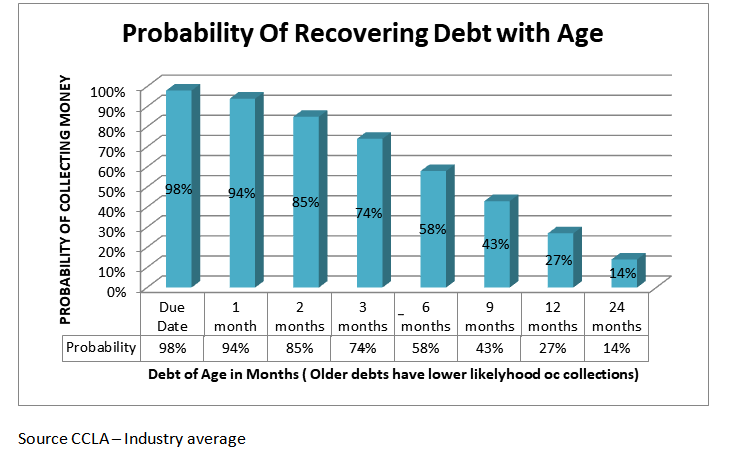
Chart shows probability of recovering unpaid invoices falls with every passing month. From 98% to just 14% by the end of 2 years.

When a client tells you, “I just need one more month,” they aren’t asking for a favor, they are asking for an interest-free loan.

Every time you say yes to a delay, the value of that invoice drops. In the debt collection industry, time is the enemy of money. Here is the reality of what happens when you wait.

Quick answer: Most invoices should move from internal follow-up to a collection agency by 90 days past due. Industry data shows recovery probability has already fallen from roughly 94% at 30 days to around 74% by 90 days, and it keeps dropping every month after that. Waiting past 90 days rarely buys goodwill; it mostly buys a smaller eventual recovery.


The Real Cost of Waiting

Recovery Probability by Invoice Age

Data commonly attributed to the Commercial Law League of America (exact figures vary slightly by source and survey year, but the pattern is consistent) shows collectability declining sharply, and non-linearly, the longer an invoice ages:

Invoice Age Estimated Recovery Probability
30 days past due ~94%
90 days past due ~74%
6 months (180 days) ~58%
1 year past due ~27%

The curve bends hardest in the first 90 days, which is exactly the window most businesses spend hoping the client “just needs a little more time.” By the time an account is a year old, roughly three out of every four dollars originally owed are gone for good.

By “being nice” and waiting another 30 days, you aren’t being a good partner; you are taking a real haircut on money you’ve already earned.

Why “Being Patient” Isn’t a Strategy

Most small to mid-sized businesses operate on thin margins. When you allow a customer to hold onto your cash, you are financing their business growth with your payroll and operating capital. Professional creditors know that the squeaky wheel gets paid first. If you aren’t creating a sense of urgency, your invoice stays at the bottom of their pile.

Recognizing Stall Tactics

A debtor who genuinely intends to pay will usually offer a partial payment or a specific date. A debtor who is in trouble will give you vague promises:

  • “The check is in the mail.”
  • “We’re waiting on a big contract to close.”
  • “Our accounting person is out this week.”
  • “We’re disputing part of the invoice” — raised for the first time only after a payment reminder, with no specifics.

These are classic stall tactics designed to keep you quiet while they pay more aggressive creditors first.

When It’s Time to Stop Calling Yourself

Many business owners hesitate to use a collection agency because they fear “ruining the relationship.”

The truth: If a client hasn’t paid you in 90 days and refuses to communicate, the relationship is already broken. Moving the account to a professional third party like Collect911 removes the emotion from the transaction and signals that your terms are serious.

A Note on Compliant Internal Collections

Even before an account reaches a professional agency, how you collect matters. Many states extend debt-collection-style communication rules, restrictions on contact frequency, prohibitions on misleading statements, required language in written notices, to original creditors collecting their own accounts, not just outside agencies. For medical practices, that sits alongside HIPAA: billing communications about a specific patient balance still need to be handled with the same care given to any other protected health information. None of this means you can’t call a client directly; it means those calls are worth treating as seriously as the ones a professional agency would make.

Final Notice Template (Before You Escalate)

Final Notice: Formal Demand for Payment
Subject: FINAL NOTICE: Outstanding Balance for [Your Business Name] – [Invoice #]
Dear [Debtor Name/Accounts Payable Team],
Despite our previous attempts to resolve your outstanding balance of $[Amount Owed], we have not yet received payment for Invoice #[Number], which is now [Number] days past due.
We value our professional relationship and have made every effort to be patient. However, we can no longer maintain this balance as an open account.
This is your final notice. Please be advised of the following:
Payment Deadline: Full payment must be received by [Date – 5 to 7 business days out].
Next Steps: If payment is not confirmed by the deadline, your account may be formally closed and transferred to a professional collection agency, our third-party debt recovery partner, for immediate action.
Consequences of Transfer: Once transferred, this matter may affect your commercial credit profile and may include additional collection costs or interest as permitted by law.
How to resolve this now: Please [Insert Payment Link/Instructions] or call us at [Your Phone Number] to confirm your wire transfer.
If you have already sent payment, please provide the transaction details immediately so we can halt the transfer process.
Sincerely,
[Your Name/Company Name] [Phone Number] [Website]

A Real-Life Scenario

A small equipment supplier had a client stall for four months with a rotating set of excuses, “the check is coming,” then “our AP person changed,” then silence. By the time the account was finally assigned at the five-month mark, the invoice was already worth roughly half what it would have been at 90 days. The business owner’s own estimate was that the three extra months of “being patient” cost more than the eventual collection fee would have, a pattern that shows up often enough that it’s worth treating as the rule rather than the exception.

The Collect911 Advantage

We don’t use “debt collector” scripts that burn bridges. We use a professional, compliant, and firm approach to get you paid.

  • Low Risk: We work on a contingency basis, generally 15% to 40% depending on account age and type. If we don’t recover your money, you owe us nothing on that account.
  • Track Record: We maintain a 4.8-star Google rating, aiming to balance strong recovery rates with professional communication.
  • Speed: Our process is built to trigger prompt action, aiming to move your invoice up the debtor’s priority list rather than letting it sit.

The Bottom Line: Don’t let another 30 days of “promises” turn into a total loss.

Frequently Asked Questions

How long should a business wait before sending an unpaid invoice to collections?

Around 90 days is the general benchmark. Recovery probability is still relatively strong before that point, but it declines meaningfully afterward, so 90 days functions as the practical line between “still worth pursuing yourself” and “worth handing to a professional agency.”

What are the primary warning signs that a client is using stall tactics?

Vague, non-specific promises rather than a concrete date or partial payment: “the check is in the mail,” a sudden staffing excuse, or a dispute raised for the first time only after a reminder is sent, with no supporting detail. A debtor who genuinely intends to pay usually offers something concrete instead.

Does sending a “Final Notice” letter myself count as debt collection activity I need to worry about compliance for?

It can, depending on your state and the nature of the debt. Even original creditors collecting their own accounts are sometimes subject to state-level rules on communication frequency, required disclosures, and prohibited statements, not just third-party agencies. It’s worth keeping any internal collection correspondence factual and professional for that reason alone.

If I send the account to collections at 90 days, do I lose the ability to negotiate directly with the client myself?

No, not typically. You generally still make the final call on settlements, payment plans, or pulling an account back, a professional agency works the account on your behalf, but major decisions usually still route through you unless you’ve agreed otherwise.

Does the 90-day rule apply the same way to patient medical bills as it does to commercial B2B invoices?

Not exactly, though the same don’t-wait-too-long principle applies. Patient balances often involve an extra step before the 90-day clock should even start counting down: insurance processing, EOB reconciliation, and, for many providers, a documented financial-assistance or charity-care screening. Once that groundwork is done and a balance is confirmed as the patient’s responsibility, the same aging math applies, waiting doesn’t make a patient more likely to pay, it just gives the balance more time to quietly become uncollectible.

Filed Under: debt

The Bursar’s Guide to Ethical Tuition Recovery | Surviving the Transcript Ban

An unpaid tuition bill shouldn’t mean a permanently burnt bridge. In higher education, the ultimate recovery isn’t just balancing the ledger, it’s clearing the path for a student to re-enroll and finish their degree. We built our nationwide tuition recovery process around student-friendly mediation: protecting your institution’s 5-star reputation, handling every account with a dedicated client specialist, and converting delinquent tuition into renewed enrollment, all without the high costs or hostility of traditional collections.

Quick answer: Collect911 recovers past-due tuition through student-friendly, out-of-court mediation, starting with a $15 fixed-fee early-intervention phase and moving to a 40% contingency model only for aged or unresponsive accounts, all FERPA-compliant and built around getting students back into re-enrollment rather than simply writing off the balance.

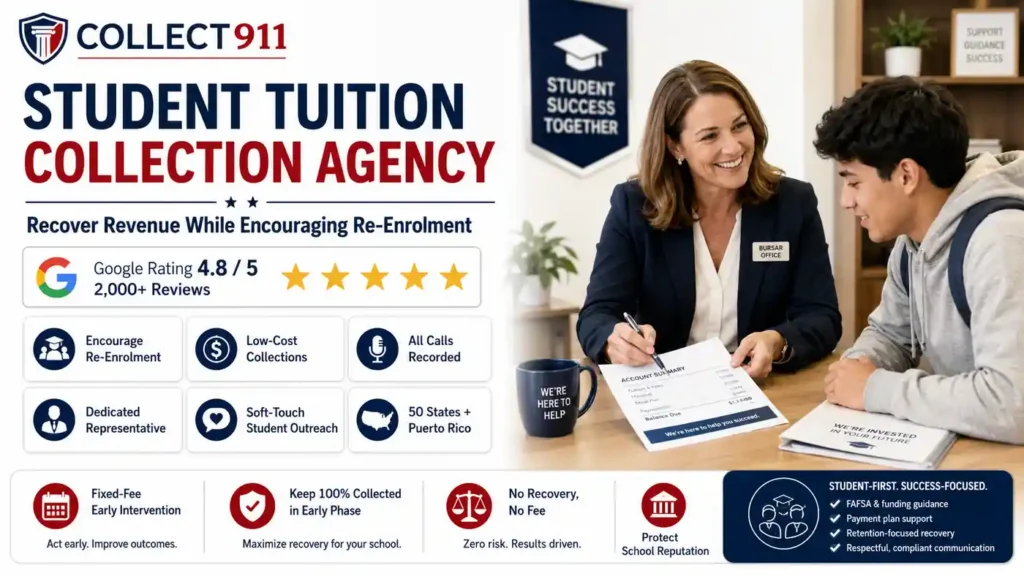
Collect911 student tuition collection agency helping colleges recover overdue balances while encouraging re-enrollment through low-cost, student-friendly collections and dedicated support.

If you are a Chief Business Officer or Bursar, you don’t need a spreadsheet to tell you that this is a fiscal tightrope. You are squeezed between two massive pressures:

  1. The Enrollment Cliff: The long-predicted demographic drop in traditional college-aged students is here. Every single enrollee is now a precious resource you cannot afford to lose.
  2. The End of Leverage: Your most effective tool for recovering unpaid tuition, the transcript hold, is being dismantled. Between the Department of Education’s administrative capability rules (34 CFR 668.14) and state-level bans in New York, California, and beyond, using transcripts to compel payment is becoming a legal liability.

At the same time, tuition discounting has hit a record high of 56.3% for first-time undergraduates. This leaves you with razor-thin margins. When a student defaults on that remaining revenue, it’s not just a “bad debt expense,” it’s a threat to your operational stability.

The old “dial-and-demand” collection model is dead. It alienates students and invites regulatory scrutiny. Here is how we help colleges recover revenue while protecting their reputation and enrollment numbers.


Protecting your college reputation, Collect911 holds licenses in all 50 states, ensuring a safe approach for every patient interaction. We provide free litigation and bankruptcy scrubs with zero onboarding or annual fees. Our SOC 2 Type II and FERPA-compliant systems ensure total data security, backed by a 4.85/5 rating from over 2,000 professional reviews. Delivering high recovery rates!

Need a Education Collection Agency? Contact us


The New Goal: Collection Through Re-Enrollment

Traditional agencies view a past-due student balance as a debt to be liquidated. We view it as a retention opportunity.

When a student drops out with a balance (often triggering a “Return to Title IV” liability for the institution), everyone loses. The student has debt but no degree; the institution has a write-off and a vacant seat.

Our recovery strategy focuses on getting the student back into the classroom.

  • The FAFSA Solution: Many students stop paying because they lost funding or missed a deadline. Our agents act as financial literacy concierges, encouraging students to complete their FAFSA and access government grants.
  • Unlocking Funds: If we can help a student resolve enough of their balance to re-register, they can often access new Pell Grants or loans. This works for the institution because these funds can effectively clear the old institutional debt over time, ensuring payment while the student completes the program they started.

Pricing: Two Flexible Recovery Paths

Path Best For Cost You Keep
Fixed-Fee Early Intervention Accounts 30–90 days past due ~$15 per account (five contacts) 100% of what’s recovered
Contingency Resolution Non-responders or accounts 120+ days delinquent 40% contingency Everything above the fee — No Recovery, No Fee

Cost of collections. Contingency and fixed fee services.

See our full pricing breakdown for details across account types.

A Strategic Workflow for the Regulatory Landscape

We operate across all 50 states and Puerto Rico, managing the complex compliance matrix of state-specific laws so you don’t have to. Most clients see the best results by moving accounts from their internal billing into our two-tiered external workflow:

Fixed-Fee Early Intervention (The “Retention” Phase)

Best for accounts 30–90 days past due. A series of diplomatic, soft-touch letters and digital reminders goes out on our third-party letterhead. The tone is helpful, not accusatory. This “nudge” effectively separates students who just forgot to pay from those with serious financial barriers, often clearing 30–40% of the queue for pennies on the dollar.

Contingency Collections (The “Resolution” Phase)

For accounts that haven’t responded to early intervention, or older delinquencies (120+ days). We deploy intensive skip-tracing to locate former students who have moved, a common issue with dropouts, and use negotiation techniques to secure voluntary repayment plans. No Recovery, No Fee, incentives stay aligned with yours.

Need a Collection Agency? Contact us


Why Colleges Are Switching to Us

We are not just a vendor; we are a partner in your revenue cycle.

  1. Compliance as a Service: We understand the nuance of the current “paid-for” transcript regulations, and help you navigate partial transcript releases so you remain compliant with federal law without giving up all your leverage.
  2. Reputation Management: Check our Google reviews. We treat students with dignity. In the age of social media, a heavy-handed collector can cause a PR nightmare. We protect your alumni relationships.
  3. National Reach: Whether a former student moved to a strict regulatory state like Massachusetts or a garnishment-friendly state, we know the local laws and how to recover funds legally.
  4. A Dedicated Account Manager: Every institution is assigned a single, dedicated representative for seamless bursar and financial aid office coordination, not a rotating cast routed through a general queue.

Standard Agencies vs. Collect911 Student-Friendly Recovery

Factor Standard Collection Agencies Collect911 Student-Friendly Recovery
Reputation Protection Often generic “dial and demand” scripts, risking public complaints Empathetic, diplomatic outreach built around institutional reputation
FERPA Compliance Varies; not always built specifically around education-record standards FERPA, FDCPA, and FCRA compliance built into every account from intake
Re-Enrollment Focus Treats the balance as debt to liquidate, full stop Treats resolution as a path back to re-enrollment where realistic
Dedicated Representative Access Often routed through a general call queue Single dedicated account manager per institution
Out-of-Court Settlement Priority Litigation-first posture on aged accounts Negotiated resolution prioritized; legal action reserved as last resort

Recent Recovery Results

Career & Technical College

An $86,000 tuition balance across multiple stalled accounts moved through our two-tiered recovery process. $57,600 was recovered, and 11 students used the resolution process to clear enough of their balance to re-enroll and continue their programs, turning a write-off into both recovered revenue and retained enrollment.

Private Liberal Arts University

$135,000 in charged-off tuition, spread across former students nationwide, was placed into our contingency program. $98,500 was recovered out of court, without litigation costs or the reputational risk of an aggressive collection posture.

Frequently Asked Questions

How does Collect911 protect our institution’s reputation while collecting past-due tuition?

Every account is handled with empathetic, diplomatic outreach rather than aggressive dial-and-demand tactics, and our own reputation is a matter of public record, worth checking our Google reviews directly. Protecting your institution’s reputation is treated as part of the recovery strategy, not a separate concern layered on top of it.

Can Collect911’s tuition recovery process actually help stop-out students re-enroll?

That’s the explicit goal, not a side benefit. Many students who stop paying have lost financial aid eligibility or missed a FAFSA deadline rather than simply refusing to pay, and our outreach is built to identify that distinction and point students toward resolving it. When a student can access new aid to clear enough of an old balance to re-register, the institution recovers the debt and keeps the student.

Is Collect911 fully FERPA-compliant when handling student financial records?

Yes. Every account is handled under FERPA’s requirements for student education records, alongside FDCPA and FCRA standards governing communication and credit reporting.

Will our institution have a dedicated account manager for bursar office coordination?

Yes. Every institution is assigned a single, dedicated representative rather than routed through a general call queue, specifically so bursar and financial aid office coordination doesn’t require re-explaining your institution’s policies to a different person every time.

What is the fee structure for educational accounts?

A fixed fee of roughly $15 per account covers early intervention (accounts 30–90 days past due), with the institution keeping 100% of anything recovered. Accounts that don’t respond, or that are already 120+ days delinquent, move to a 40% contingency model, no recovery, no fee.

A veteran student’s GI Bill benefits haven’t been disbursed yet, and their account shows as delinquent in the meantime. Should this be treated the same as an ordinary past-due balance?

No, and treating it that way risks a genuinely unfair outcome. VA disbursement delays are common and outside the student’s control, so an account that’s delinquent only because of a pending Post-9/11 GI Bill payment needs a different first move: confirming the certification and expected VA payment timeline before any collection outreach begins, not after. These accounts get flagged separately rather than run through the standard cadence.

If a student’s balance came from a Return to Title IV recalculation after they withdrew, is that debt collectible the same way as an ordinary tuition balance?

Generally yes, once it’s actually confirmed as owed, but it’s worth double-checking the R2T4 math before pursuing it aggressively. A Return to Title IV recalculation can leave a student owing an institutional balance that didn’t exist before their withdrawal, and errors in that calculation aren’t uncommon. These accounts are treated as legitimate debt once verified, but a student disputing the R2T4 math itself deserves a real look, not a form-letter response.

A former student defaulted and then left the country. Is there any realistic way to collect?

It’s genuinely harder, and worth setting expectations accordingly. Domestic skip-tracing, credit bureau reporting, and most legal remedies assume a U.S. address and credit history, none of which apply once a student has returned home. The more realistic levers become institutional rather than financial: whether a diploma or transcript request can be conditioned on the balance where legally permitted, or whether the student would need a clean account to apply to a different U.S. institution later.

The page mentions “partial transcript releases.” What does that actually mean in practice?

It’s a middle ground between withholding a transcript entirely, increasingly restricted or banned outright in a growing number of states, and releasing it with no leverage at all. In practice, this usually means releasing an official transcript for a specific, legitimate purpose, transferring credits, applying for a job, while still declining to issue things like a diploma or a fully “resolved” academic record until the balance is addressed. The exact line depends on the specific state’s transcript law, so this gets evaluated institution by institution rather than applied as a blanket rule.


The enrollment cliff means you cannot afford to lose students, and the regulatory shifts mean you cannot afford to be non-compliant. Let’s modernize your receivables strategy to recover more tuition, retain more students, and stabilize your balance sheet.

Need a College Tuition Collection Agency? Contact us

Filed Under: debt

  • « Go to Previous Page
  • Page 1
  • Page 2
  • Page 3
  • Page 4
  • Page 5
  • Go to Next Page »

Primary Sidebar

Highly Rated Collection agency
Contact Us:

Need a Collection Agency?
Kindly fill this form.
We’ll get in touch with you


    Please prove you are human by selecting the cup.

    • Free Bankruptcy screening.
    • Free Credit Reporting (If law permits).
    • Free Change of Address check
    • Litigious defaulter check.
    • A 5-star rated agency !

    Our aim is to provide all debtors a convenient path towards eliminating their debt in a consumer friendly manner.

    Featured Posts

    • Top Hospital & Medical Collection Agency in Indiana
    • Colorado Collection Agency: Modern Revenue Cycle Strategies
    • Medical & Hospital Debt Collection Agency | No Upfront Fees
    • Challenges and Considerations in Commercial Credit Reporting
    • Commercial Collection Agency: 75% Success Rate | 20 Years Experience

    Exclusive Posts

    • Top Hospital & Medical Collection Agency in Indiana
    • Top Nevada Collection Agency for Patient Revenue Cycles
    • Idaho Medical Collection Agency: Recover Patient Balances
    • Georgia Medical Collection Agency: Recover Patient Balances
    • Delaware Medical Collection Agency: Recover Patient Balances
    • Colorado Collection Agency: Modern Revenue Cycle Strategies
    • Top Arkansas Collection Agency for Patient Account Solutions
    • Top Arizona Collection Agency for Patient Account Solutions
    • Top Alaska Collection Agency for Patient Account Reconciliation
    • Top Alabama Collection Agency for Unpaid Patient Bills
    • Respectful Medical Collections for Ohio Clinics & Hospitals
    • Medical Collection Agency in Illinois: Recovering Patient Bills
    • Medical Collection Agency in Pennsylvania: Recovering Patient Bills
    • Restoring Texas Medical Vitality: Medical Collection Agency
    • Healthcare Collection Agency: Restoring California’s Medical Vitality
    • Best Collection Agency LA & San Diego: Medical & Business Recovery
    • The 90-Day Deadline: When to Stop Calling and Start Collecting
    • The Bursar’s Guide to Ethical Tuition Recovery | Surviving the Transcript Ban
    • Collection Agency Market Overview
    • Recover Rent Faster: Student Apartment Collection Agency
    COPYRIGHT: COLLECT911 | 2026
    This content is provided for general informational purposes only and should not be considered legal advice. Collection laws and requirements may vary by state, account type, documentation, debtor status, and specific facts. Please consult qualified legal counsel for guidance regarding your particular situation. Collect911 and its authorized collection partners service accounts in accordance with applicable federal and state collection requirements. Visit our home page to know more about us.
    X
    Need a Collection Agency?
    Contact Us