• Skip to main content
  • Skip to primary sidebar

Collect911

  • Home
  • Pricing
  • Contact Us

Collections

California’s Trusted Collection Agency for Business & Medical Debt

Recover Revenue. Protect Your Reputation. Stay Compliant.

You provided the service. You sent the invoice. You deserve to be paid.

Collect911 is a premier debt recovery firm serving the entire state of California. Whether you are a medical practice in Los Angeles, a tech startup in San Francisco, or a logistics company in Long Beach, we recover your funds while maintaining the professional relationships you’ve worked hard to build.

At a Glance: Why CA Businesses Choose Us

  • Industry-Leading Recovery Rates: We outperform national averages by leveraging advanced skip-tracing and credit reporting.

  • 100% Compliant: Strictly adhering to the Rosenthal Act, HIPAA, and FDCPA.

  • 4.8/5 Star Rating: Trusted by clients with over 2,000+ Google Reviews. Rated 4.8 /5.

  • Statewide Reach: Serving San Diego, San Jose, Sacramento, Fresno, and every city in between. Licensed in all 50 states, so if your debtor crossed state lines, we can continue to pursue collections.


Two Flexible Pricing Models

We don’t believe in one-size-fits-all. Choose the plan that fits your cash flow.

1. Contingency Service (No Recovery, No Fee)

Best for older or difficult debts. We shoulder the risk.

  • Zero upfront cost.

  • We only get paid when you get paid.

  • Includes comprehensive skip-tracing, credit bureau reporting, and litigation support if needed.

2. Fixed-Fee Service (Pre-Collection)

Best for recent debts (under 90 days). Keep 100% of the money collected.

  • Pay a small, flat fee per account.

  • Monies are paid directly to you.

  • Acts as a gentle extension of your billing department to nudge payments without burning bridges.

Industry-Specific Expertise

For Medical & Dental Practices

Patients are not just debtors; they are your community. California’s medical landscape requires a delicate touch. We specialize in collecting for Dentists, Urgent Care, and Private Practices while strictly adhering to HIPAA and California medical billing regulations. We recover the funds without triggering malpractice claims or negative online reviews.

For Commercial (B2B) Business

Don’t let unpaid invoices choke your cash flow. From Silicon Valley SaaS contracts to Construction liens and Freight/Logistics disputes, we understand commercial leverage. We report to commercial credit bureaus (Dun & Bradstreet, Experian Business), giving debtors a powerful incentive to pay you first to protect their own credit lines.


Ironclad Compliance & Security

California has some of the strictest collection laws in the nation. One mistake can lead to a lawsuit. We protect you by handling the legal complexities.

  • The Rosenthal Fair Debt Collection Practices Act (RFDCPA): We strictly follow California’s specific extension of federal law, ensuring no harassment or unfair practices.

  • Data Security: Your data is protected by 256-bit encryption and our client portal features Two-Factor Authentication (2FA).

  • Statute of Limitations: We monitor California’s 4-year statute on written contracts so you never miss a legal window to collect.

  • No Hidden Fees or Commitments: Enjoy our services without any minimum balance requirements, minimum number of accounts, setup fees, or binding contracts. Our customer agreement is open-ended and non-committal.

  • Complimentary Credit Bureau Reporting: Benefit from free credit bureau reporting, enhancing the effectiveness of our collection efforts.

  • High Recovery Rates with Full Compliance: We achieve excellent recovery rates while strictly adhering to FDCPA, HIPAA, TCPA, and GLBA regulations.

  • Personalized Support: Beyond our central customer service team, you’ll have a dedicated Sales Representative assigned to you for direct, personalized assistance.


Areas We Serve

We are fully licensed and bonded to collect anywhere in California, including:

  • Southern California: Los Angeles, San Diego, Long Beach, Anaheim, Riverside.

  • Northern California: San Francisco, San Jose, Oakland, Sacramento, Fresno.

  • Central Coast & Inland Empire.

Wage Garnishment

  • California has specific laws that limit the amount of wages that can be garnished to repay a debt. The state provides greater protection than federal law, allowing only the lesser of 25% of a worker’s disposable earnings or the amount by which a worker’s disposable earnings for the week exceed 40 times the state minimum hourly wage.
  • Certain types of income, like social security, disability, and retirement, are exempt from garnishment in California.

Ready to Clear Your A/R Ledger?

Don’t let another 30 days pass. The older a debt gets, the harder it is to collect.

Need a Collection Agency for your unpaid Invoices? Contact us

 

Filed Under: Collections

Commercial Collection Agency: 75% Success Rate | 20 Years Experience

Collections manager congratulating commercial debt collectors for high recovery wins.

Commercial Recovery: Moving Beyond the “Check is in the Mail”

You’ve sent the invoice. You’ve called Accounts Payable. You’ve been promised “the check is in the mail.” For a CFO, controller, or credit manager, that’s usually the signal to stop chasing and start escalating. Our Account Reconciliation Team bypasses the gatekeepers and gets your invoice in front of the person who actually approves payment, serving hundreds of businesses nationwide to resolve the billing gridlock that’s stalling your accounts receivable.

Quick answer: The earlier a delinquent B2B account moves to professional recovery, the higher the odds of getting paid. Accounts under 180 days past due recover at roughly 80%; that rate falls the longer an invoice sits, since a debtor’s cash, attention, and willingness to prioritize an aging vendor bill all decline with time. Commercial debt collection works best as a structured, early escalation, not a last resort after months of internal follow-up.

Our recovery rate runs over 75% for B2B accounts less than 250 days old, climbing to about 80% for accounts under 180 days. More than 90% of accounts resolve without ever filing suit. No Recovery = No Fee.


Protecting your business reputation, Collect911 holds licenses in all 50 states, ensuring a safe approach for every client interaction. We provide free litigation and bankruptcy scrubs with zero onboarding or annual fees. Our SOC 2 Type II ensure total data security, backed by a 4.85/5 rating from over 2,000 professional reviews. Delivering high recovery rates!

Need a Commercial Collection Agency? Contact us


In-House Follow-Up vs. Professional Commercial Recovery

Metric In-House A/R Follow-Up Collect911 Commercial Recovery
Staff time required Ongoing, competing with the rest of your finance team’s workload Minimal — account is handed off, tracked through updates
Recovery probability (180+ days past due) Declines sharply without dedicated leverage or tools ~75–80% on accounts under 250 days
Commercial credit bureau reporting Not typically available to an individual creditor Available for eligible accounts, adds real pressure
Skip tracing & asset investigation Limited to what staff can find manually Litigation, bankruptcy, UCC, and address checks included
Legal escalation Requires sourcing and vetting outside counsel separately In-network attorney referral with pre-litigation analysis

The Performance-Based Recovery Model

Our commercial strategy is results-driven with zero upfront risk to your firm. We operate on a Tiered Contingency model: no recovery, no fee. Fees range from 10% to 45% depending on the balance, age, and complexity of the account, communicated to you in advance for total transparency. This aligns our incentives with yours, applying 20+ years of commercial credit and recovery experience to resolve balances efficiently.

Cost of commercial recovery is based on age and balance. ranges from 10% to 45% in contingency fee.

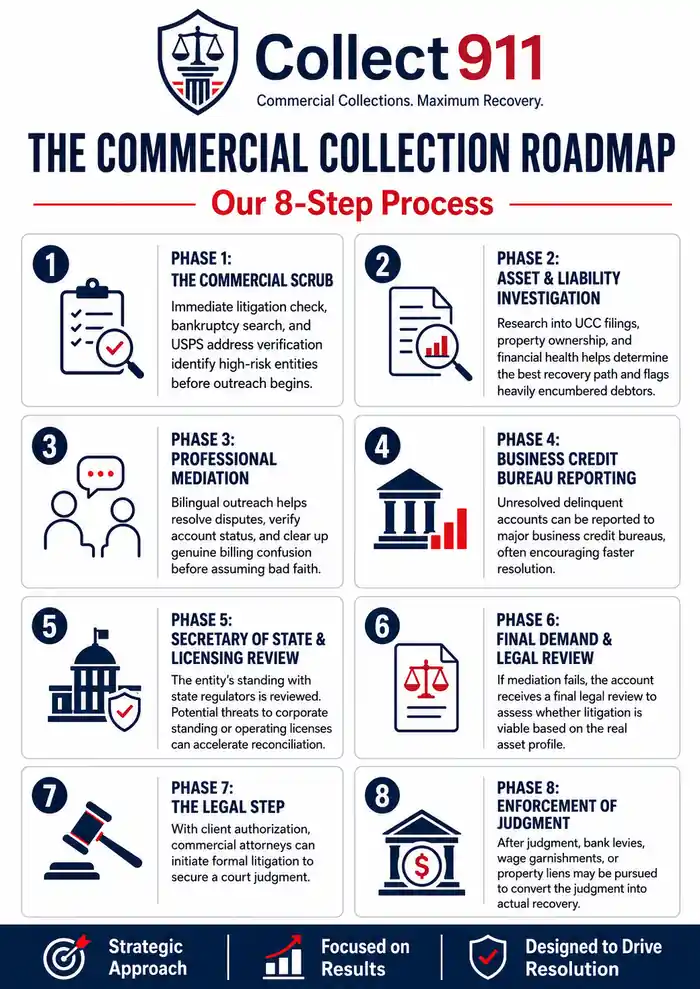
The Commercial Collection Roadmap: Our 8-Step Process

Out-of-court settlement is always our top priority. We use advanced negotiation, compliance-driven outreach, and credit reporting leverage to resolve delinquent accounts amicably. This approach recovers your money faster, protects professional relationships, and saves you hundreds in court costs and legal fees.

Collect911 infographic outlining an eight-step commercial collection process, from account screening and asset investigation to legal action and judgment enforcement.

Phase 1: The Commercial Scrub

Every account undergoes an immediate litigation check, bankruptcy search, and USPS address verification to identify high-risk entities before any outreach begins.

Phase 2: Asset & Liability Investigation

Deep-dive research into the entity’s financial health, including UCC filings and property ownership, determines the most effective recovery path, and flags accounts where a debtor’s assets are already heavily encumbered elsewhere.

Phase 3: Professional Mediation

Bilingual outreach acts as a professional intermediary to resolve disputes and verify account status, aiming to clear up genuine billing confusion before assuming bad faith.

Phase 4: Business Credit Bureau Reporting

If an account remains unresolved, the delinquency can be reported to major business credit bureaus, impacting the entity’s ability to secure future credit and often prompting faster resolution.

Phase 5: Secretary of State & Licensing Review

The entity’s standing with state regulators is verified. Flagging potential threats to corporate standing or operating licenses often accelerates reconciliation.

Phase 6: Final Demand & Legal Review

If mediation fails, the account is escalated for a final legal review to determine whether litigation is viable given the entity’s actual asset profile, not just the size of the balance.

Phase 7: The Legal Step

With your authorization, our network of commercial attorneys initiates formal litigation as a final action to secure a court judgment.

Phase 8: Enforcement of Judgment

Post-judgment, bank levies, wage garnishments, or property liens are pursued where available to convert the judgment into an actual recovery.

Clinical Philosophy: Urgent, Effective, and Respectful

As an Account Reconciliation Team, we operate as an authoritative peer to your accounting department, not an outside collections operation. A late payment is often a breakdown in communication rather than a refusal to pay, so acting as mediators resolves discrepancies without damaging long-term vendor relationships. This frees your staff to focus on growth rather than the grind of chasing balances.

The Security & Integrity Suite

Integrity is non-negotiable. Every call is recorded and audited to protect professional standards and your reputation. A litigation check at intake identifies debtors with a documented history of using frivolous lawsuits to avoid paying, a real and growing tactic among sophisticated commercial debtors.

Realistic Smart Collection Methodology

A wholesale equipment distributor had a single commercial account, a regional contractor, fall 140 days past due on a $72,000 order of heavy machinery parts. Internal follow-up calls had gone unanswered for two months. An asset and liability check found the contractor was mid-bid on several new municipal contracts, giving real weight to a credit-bureau reporting threat, since a delinquency mark could jeopardize their bonding and bidding eligibility. Within three weeks of that leverage being applied, $65,400 of the balance was recovered through a negotiated payment plan, avoiding litigation entirely.

Here are two more recent B2B commercial debt recovery results:

Result 1: The Building Materials & Wholesale Distributor

  • The Situation: A regional building supplies distributor was owed $82,000 by a commercial subcontractor who had gone completely silent after completing a project. The invoice was 140 days past due, and the client’s internal accounts receivable team was receiving standard stall tactics (“we’re waiting on general contractor funding”).

  • The Solution: The distributor submitted the account to Collect911’s B2B commercial recovery program. The team immediately conducted corporate asset discovery and skip-tracing, identified active business operations, and issued a firm, compliant formal commercial demand notice.

  • The Result: Within 21 days, Collect911 negotiated a structured 2-part payment agreement. The full $82,000 balance was recovered in full, allowing the distributor to avoid writing off a massive margin-draining loss.

Result 2: The Industrial Equipment Rental & Logistics Firm

  • The Situation: An equipment rental firm was holding $45,500 in overdue balances across three separate commercial accounts ranging from 90 to 180 days past due. The debtor companies were ignoring direct staff emails and withholding payment while continuing operations elsewhere.

  • The Solution: The firm transferred the accounts to Collect911’s Performance Contingency commercial model. Collect911 initiated pre-litigation analysis and leverage via commercial credit bureau reporting options, signaling that the debts would directly impact the debtors’ corporate credit profiles.

  • The Result: Within 35 days, two debtors paid their balances in full, and the third entered a verified payment schedule. Collect911 recovered $39,800 (87.4%) of the total outstanding commercial debt without requiring costly courtroom litigation.

Frequently Asked Questions

What’s a typical contingency rate for B2B debt recovery, and why does it vary so much?

Rates generally run 10% to 45%, and the spread comes down to age, complexity, and dollar size rather than being arbitrary. A fresh, well-documented $50,000 invoice is a very different recovery project than a $3,000 balance that’s been stale for two years and needs skip tracing just to find a working address. The fee should track the actual work and risk involved in a specific account, not a flat number applied across the board.

Our delinquent customer is a franchisee. Can we pursue the franchisor for the unpaid balance?

Usually not, and it surprises a lot of suppliers. Franchise law generally treats a franchisee as an independent business responsible for its own trade debts, and a franchisor typically isn’t on the hook just because their name is on the sign outside. The exceptions are narrow: a franchisor that personally guaranteed the account, or one so operationally entangled with the location that a court treats it as the franchisee’s true employer or principal, which is a high bar. Knowing which entity actually signed your credit application matters more here than which brand is on the building.

The account that owes us is a government agency or municipality. Does that change how collection works?

Significantly. Government entities generally can’t be pursued the same way a private company can; sovereign or governmental immunity often blocks standard lawsuits and asset seizure, and many agencies have their own required claims process that has to be followed before a court will even hear the matter. Wage garnishment and bank levies, the usual post-judgment tools, frequently aren’t available against a public entity’s operating funds at all. These accounts almost always call for a different playbook than a private commercial debtor.

We just learned our invoice was already sold to a factoring company. Does that change who we’re actually owed by, or who can collect?

It can shift the account out of your hands entirely. Once a receivable is genuinely sold to a factor, the factor typically owns the right to collect it, not the original business, and their own factoring agreement usually dictates who pursues a nonpaying account and under what terms. Before assuming you can place that invoice with us directly, it’s worth confirming whether the sale was a true sale or a recourse arrangement where the obligation could come back to you.

Our research turned up a UCC-1 blanket lien from the debtor’s bank. Is the account still worth pursuing?

Often, yes, just with adjusted expectations rather than none at all. A blanket lien means a secured lender has first claim on the debtor’s assets in a liquidation or bankruptcy scenario, which affects what’s realistically recoverable if things go that far, but it doesn’t erase an ordinary business’s incentive to pay a routine trade invoice to keep operating and preserve vendor relationships outside of a worst-case scenario. This is exactly the kind of finding our Asset & Liability Investigation step is meant to surface early.

Could we get sued for harassment or an FDCPA-style violation while trying to collect a B2B debt ourselves?

It’s a real risk, more than most business owners assume. While the federal FDCPA is written around consumer debt, a number of states have their own statutes that extend similar communication and conduct restrictions to original creditors collecting commercial debt, and even outside those laws, a debtor pushed too hard has other legal theories, harassment, defamation, tortious interference, available if a collection effort gets aggressive or public. This is part of why moving a stalled account to a professional team is often the lower-risk path, not just the more effective one.

Areas of Commercial Expertise

  • Commercial Lease & Property Management Arrears
  • Manufacturing & Supply Chain Invoice Reconciliation
  • Professional Services & Consulting Balances
  • Wholesale & Distribution Account Recovery
  • SaaS & Technology Subscription Arrears
  • Construction & Subcontractor Payment Disputes

Ready to Clear Your A/R Ledger?

Don’t let unpaid invoices choke your cash flow. Let us apply the professional pressure needed to get you paid.

Get a Commercial Recovery Quote

Filed Under: Collections

Senior Living Collection Agency: Protecting Your Census & Cash Flow

You provide the care. We ensure the assets are used to pay for it.

Running a Senior Living community is a balancing act between compassionate care and financial reality. When a resident falls behind on rent or Level of Care (LOC) fees, it is rarely a simple case of “refusal to pay.” It involves complex layers of family dynamics, Power of Attorney (POA) mismanagement, Medicaid “spend-down” confusion, and estate probate issues.

At Collect911, we don’t just send letters. We navigate the legal and emotional complexities of senior housing to recover the revenue you are owed—without triggering State Survey citations or PR nightmares.


Protecting your practice’s reputation, Collect911 holds licenses in all 50 states, ensuring a safe approach for every patient interaction. We provide free litigation and bankruptcy scrubs with zero onboarding or annual fees. Our SOC 2 Type II and HIPAA-compliant systems ensure total data security, backed by a 4.85/5 rating from over 2,000 professional reviews. Delivering high recovery rates!

Need a Medical Collection Agency? Contact us


Flexible Pricing for Every Scenario

1. Pre-Collect Service (Fixed Fee)

  • Best For: Current residents 60-90 days past due.

  • Cost: Low flat fee (e.g., ~$15/account).

  • Method: A diplomatic “Audit & Reminder” approach sent in your name.

  • ROI: You keep 100% of the recovered funds.

2. Contingency Collections (Standard)

  • Best For: Move-outs, deceased accounts, or hostile families. Accounts over 120 days.

  • Cost: A percentage of the collected amount.

  • Risk: No Recovery, No Fee. If we don’t collect, you pay $0.

The “Hidden” Cost of Unpaid Senior Living Debt

In the senior living industry, margins are tighter than ever. According to recent industry data, the average Assisted Living facility operates with a margin of just 28-32%, while Skilled Nursing Facilities (SNFs) often run closer to 1-3%.

Every unpaid invoice hits your bottom line directly.

  • Average Bad Debt: A single unpaid move-out in senior living averages $4,500 – $12,000.

  • The “POA” Factor: It is estimated that over 60% of senior living bad debt is caused not by the resident’s lack of funds, but by the financial mismanagement of the adult child or legal guardian controlling the checkbook.

We stop this leakage by holding the financial decision-makers accountable.


Our 3-Pronged Recovery Strategy

We categorize every account to apply the correct legal pressure:

1. The “Negligent POA” Strategy

The most frustrating scenario for an Executive Director is seeing a resident with a pension and Social Security, yet the rent remains unpaid.

  • The Approach: We bypass the resident and target the fiduciary. We remind the Power of Attorney (POA) of their legal obligation to use the resident’s assets for care first.

  • The Leverage: Misappropriating a senior’s funds can be a criminal offense in many states. When a POA realizes that their own financial conduct could be scrutinized, payment is often prioritized immediately.

2. The Estate & Probate Strategy

When a resident passes away, families often claim, “Mom had no money left.”

  • The Reality Check: We conduct deep-dive Probate and Asset Searches. We identify real estate transfers, life insurance payouts, or hidden Trusts.

  • Creditor Claims: If an estate is opened, we file the necessary paperwork to ensure your facility is listed as a priority creditor before the inheritance is distributed to the heirs.

3. The “Medicaid Gap” Strategy

Waiting for Medicaid approval can leave a facility with months of unpaid “Share of Cost” (NAMI) balances.

  • The Solution: We pursue the Patient Liability portion aggressively. Retroactive Medicaid payments go to the facility, but the “Share of Cost” often gets stuck in the resident’s bank account. We ensure that money comes to you, not the family.


Collections Without Eviction: The “Census Protection” Model

Your goal is to keep your beds full. Involuntary discharge is a regulatory minefield involving Ombudsmen, 30-day notices, and safe discharge planning.

We act as a buffer. By involving a third-party agency, we change the dynamic. We can often negotiate payment plans or “catch-up” structures that allow the family to resolve the debt so the resident can remain in your community. We recover the funds, you keep the census.


Compatible with Your Technology

Your Business Office Manager (BOM) is already overworked. We make placement seamless. We are experienced in reading and ingesting Resident Ledgers and Aging Reports from major platforms, including:

  • PointClickCare (PCC)

  • MatrixCare

  • Yardi / Voyager

  • RealPage

  • Eldermark

Whether you are a single-site owner or a REIT with 50+ communities, our portal can handle your data securely.

Frequently Asked Questions (FAQ)

Can you collect if the resident has passed away?

Yes. Death does not extinguish the debt. The debt becomes a liability of the resident’s Estate. We specialize in identifying estate assets and filing claims to recover funds from the inheritance process.

Do you sue residents?

Litigation is a last resort and is only done with your explicit written permission. Our primary focus is diplomatic recovery that preserves your reputation.

Will this upset the family?

It is often the family (the POA) who is causing the issue. Our team is trained to be firm but respectful. We explain that resolving the debt is in the best interest of the resident’s continued care.

Is there a minimum balance?

No. We understand that even small ancillary charges add up. We have solutions for balances of all sizes.


Stop Subsidizing Your Residents’ Families

You have provided the care, the meals, and the safety. You deserve to be paid for it. Let us handle the uncomfortable financial conversations so your team can focus on the residents.

We are experts in Senior Living Debt Collection

Contact Us – Serving all 50 states 

Serving some of the biggest names in your industry.


Filed Under: Collections

Small Business Collection Agency: Get Paid Without Burning Relationships

You didn’t start a plumbing company, a marketing agency, or a landscaping crew to become a part-time debt collector. But that’s what happens once an invoice crosses 60 days: now it’s you making the awkward follow-up call, hoping this time the client actually picks up. That’s not the skill you built a business around, and it’s not a good use of it either. We make that call instead, professionally enough that most customer relationships survive it, and persistently enough that most of them pay.

Quick answer: Collect911 helps small business owners recover unpaid invoices by starting with a low-cost, documented fixed-fee outreach for fresh accounts, and shifting to a no-recovery-no-fee contingency model for older or unresponsive ones, so you’re never spending your own time chasing a client personally or paying more than the situation justifies.

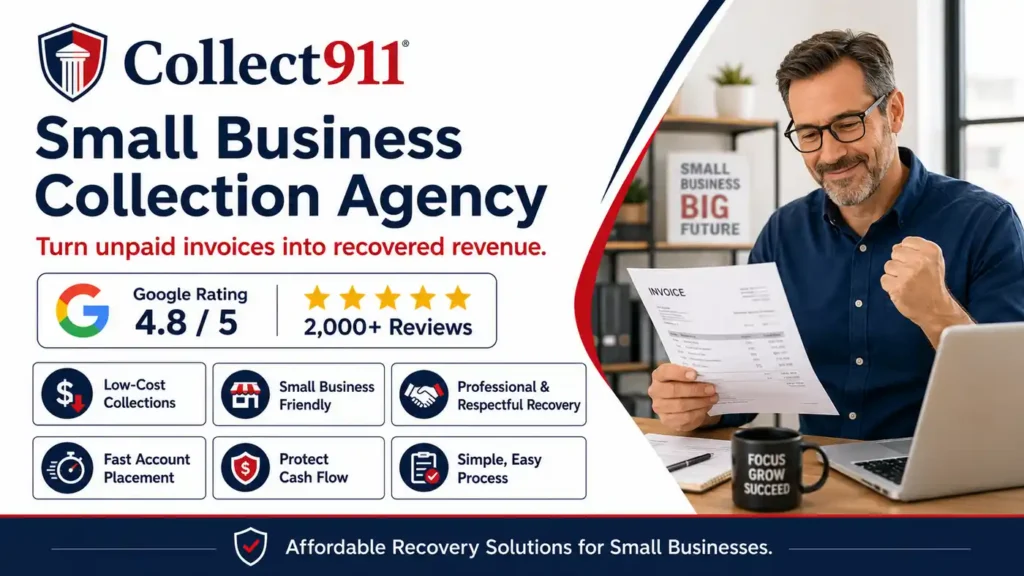
Collect911 small business collection agency offering low-cost, professional invoice recovery, with a 4.8 Google rating from more than 2,000 reviews

If you run a small business, unpaid invoices don’t just “hurt cash flow.” They delay payroll, stall growth, and force you into conversations you never wanted to have with people you’d rather keep as customers.

Our job is simple: recover what you’re owed with a secure, compliant, reputation-protecting approach, so you get paid without escalating drama or damaging future relationships. Community and word-of-mouth matter enormously for a small business, and that’s built into how every account is handled, not treated as an afterthought.

  • Licensed in All 50 States
  • Highly Rated — 4.85/5 across 2,000+ Google Reviews
  • No Minimums

Our Services and Cost:

We offer two clear collection options:

  • Fixed-fee collections (best for newer accounts and high-volume placements)
  • Contingency collections (no recovery, no fee, best for older or harder accounts)

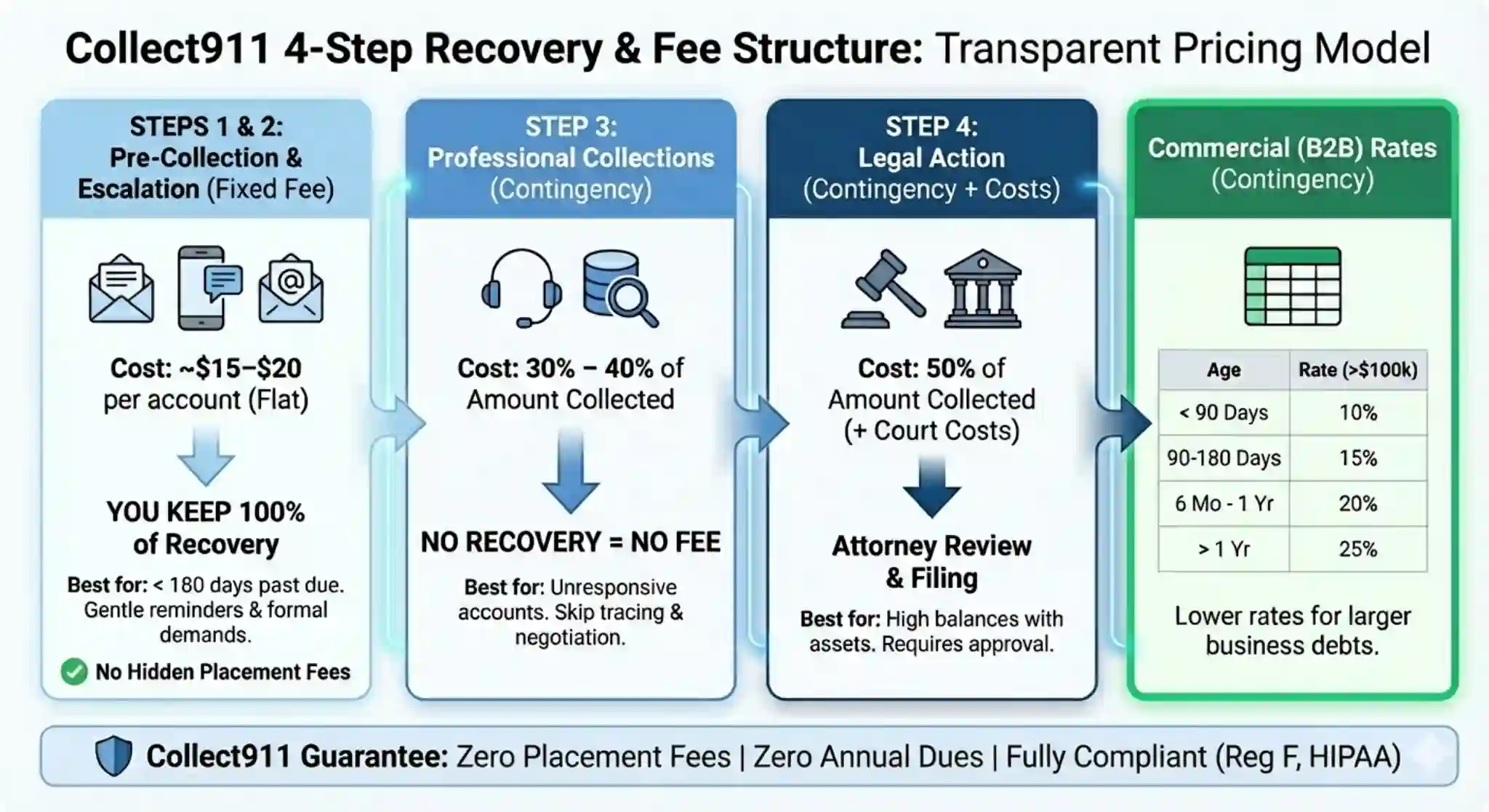
Cost of collections. Contingency and fixed fee services.

Collections law carries more overlapping rules than most small business owners expect, FDCPA-adjacent restrictions, state-level equivalents, TCPA limits on calls and texts, and self-collecting past a certain point is a genuinely risky way to find that out the hard way. Starting with a documented, low-cost fixed-fee phase before any collection calls happen, with every call recorded for compliance review, keeps you on the safer side of that line while still getting paid.

Need a Collection Agency? Contact us

Serving small businesses in all 50 states

HVAC Contractors, Plumbers, Landscapers, Electricians, Roofers, Pest Control Services, General Contractors, Painters, Flooring Specialists, Cleaning Services, Auto Repair Shops, Mechanics, Towing Companies, Property Managers, Equipment Rental Companies, Veterinarians, Chiropractors, Dental Offices, Urgent Care Clinics, Private Schools, Daycares, Gyms & Fitness Centers, Event Planners, Photographers, IT Consultants, Web Designers, Marketing Agencies, staffing agencies, Accountants, Law Firms, Funeral Homes, Security Companies, Moving Companies, Pool Maintenance Services, Handyman Services, Locksmiths, Tree Service Companies, Janitorial Services, Waste Management, Logistics & Trucking Companies, Wholesalers, Distributors, Manufacturing Companies, Printing Shops, Sign Companies, Caterers, Bakeries, Florists, Wedding Venues, Interior Designers, Architects, Engineers, Surveyors, Real Estate Agencies, HOA Management.

When Small Businesses Should Stop “Following Up” and Start Collecting

Most businesses wait too long because they don’t want to look aggressive. The problem is: time is the enemy of recovery.

  • 0–30 days past due: internal reminders and customer service follow-up
  • 31–60 days: structured escalation (firm reminders + documentation request)
  • 61–90 days: demand-level communication begins
  • 90–120+ days: response rates usually drop sharply, act fast

If your invoice is already 60+ days past due, you’re not “reminding” anymore, you’re negotiating from weakness.

Fixed Fee vs. Contingency: Which One Fits Your Situation?

Fixed-Fee Collections (Predictable Cost)
Best when you have fresh accounts (typically under 90 days past due), you place multiple accounts per month, or you want structured letters and calls without giving up a percentage of what’s recovered.

Contingency Collections (No Recovery, No Fee)
Best when accounts are older (120+ days), you want maximum pressure and persistence, or you only want to pay if money is actually recovered.

Typical contingency ranges in the market run 15% to 40% depending on age, balance size, documentation quality, and dispute status, see our full pricing breakdown for specifics.

The Excuses That Keep Small Business Invoices Unpaid

Three excuses show up more than any others, and they need different responses, not the same escalation script:

  • “We’re waiting on the general contractor / our customer to pay us first” — a pay-when-paid or pay-if-paid claim, common in trades and subcontracting, and not always as ironclad as it sounds (see the FAQ below).
  • “The work wasn’t done to scope” — sometimes a genuine dispute, sometimes a stall tactic invented after a payment reminder arrives. The paper trail usually tells you which.
  • “I don’t have anyone to chase this down” — the most common reason small businesses let invoices age past the point of easy recovery. You don’t need dedicated A/R staff to place an account with us.

In-House Collections vs. Partnering with Collect911

Metric Handling A/R In-House Partnering with Collect911
Time cost Owner or staff time spent on calls, often nights and weekends Minimal — documented and handed off
Recovery on aged accounts Drops sharply past 60–90 days without dedicated leverage Retains meaningful recovery odds well past 90 days
Tools available Phone calls, emails, maybe a strongly worded letter Skip tracing, credit bureau reporting, legal network
Relationship risk Personal and can feel confrontational coming directly from the owner A neutral third party absorbs the friction
Cost if nothing is recovered Your time is already spent regardless of outcome $0 under contingency; fixed-fee is a small flat cost either way

Our Collection Process (Built for Small Businesses)

You don’t need a “scary” approach to get paid, you need a professional, persistent, documented one.

Step 1: Document Check + Strategy (Fast Start)
We start by validating what wins collections: invoice or statement, contract, PO, or written authorization, proof of work or delivery (emails, signed acceptance, work orders), and the best contact info for decision-makers.

Step 2: Structured Outreach (Multi-Touch)
A consistent contact pattern, not one call and a shrug. Expect multiple touchpoints across 2–3 weeks (calls, email, formal notices), designed to reach the person who can actually approve payment.

Step 3: Negotiation That Protects Your Brand
We push for resolution while avoiding unnecessary friction: clear settlement options when appropriate, payment plans that actually stick, and written confirmation for every arrangement.

Step 4: Escalation Only When It Makes Sense
If a debtor ignores every reasonable attempt, we escalate with stronger actions, without jumping to legal threats on day one. Legal escalation is a last resort, used when documentation and economics justify it.

“Reputation-Protecting” Collections: What That Actually Means

Small business owners worry about reviews, referrals, and industry reputation, and you should. Our approach is built to communicate firmly but professionally, avoid tactics that backfire into a bad review, document every step so you’re protected if a debtor complains later, and keep the tone consistent with how a serious finance department would pursue payment. Every call is recorded for compliance review, and you’re assigned a dedicated representative whose direct line you’ll have for anything that comes up mid-engagement, not just a general support queue.

This is how you recover money and keep your brand intact.

Common Small Business Debts We Recover

  • Unpaid B2B invoices (services, products, recurring retainers)
  • Past-due commercial accounts (vendors, suppliers, logistics, trades)
  • Subscription or contract balances
  • Professional services invoices (marketing, IT, staffing, consulting)
  • Medical and dental patient balances (where applicable and compliant)

Recent Recovery Results

The Specialty Trade & Mechanical Contractor

The Situation: A regional commercial HVAC and plumbing contractor was holding $52,000 in delinquent invoices across four commercial job sites, all sitting between 90 and 150 days past due. The owner was spending evenings sending manual reminders and dealing with classic contractor stall tactics (“we’re waiting on general contractor funding”).

The Solution: The contractor enrolled the delinquent accounts into Collect911’s small business recovery program, starting with the $15 fixed-fee early intervention letter sequence backed by corporate skip-tracing to verify active business assets and ownership.

The Result: Within 30 days, Collect911 recovered $39,500 (76%) in direct, out-of-court payments. Two commercial accounts resolved their balances in full after receiving formal notice, and a third entered a verified two-part settlement plan.

The Independent Wholesale & Equipment Supplier

The Situation: A local B2B equipment supplier had $74,000 in overdue balances tied up in three commercial accounts past 120 days. The buyers had gone silent, and the supplier was hesitant to hire an expensive attorney that would swallow 33–40% of their thin operating margins.

The Solution: The supplier placed the accounts into Collect911’s Performance Contingency model. Collect911 initiated firm, compliant mediation supported by commercial credit bureau reporting leverage, signaling that the outstanding debt would directly affect the buyers’ corporate credit standing.

The Result: Within 45 days, Collect911 recovered $65,000 (87.8%) of the total outstanding debt out of court, restoring cash flow to the supplier without requiring litigation expenses.

Frequently Asked Questions

How fast do you start?

Most accounts can be initiated within 24–48 hours once documentation is received. There’s no minimum balance and no minimum number of accounts to place.

How small of a balance can Collect911 collect for a small business?

There’s no practical floor. Whether it’s a $150 unpaid invoice or a $50,000 commercial balance, the same documented, professional process applies, since a small business’s cash flow can depend on a $300 account just as much as a $30,000 one.

My client says they haven’t been paid by their own customer yet, so they can’t pay me. Is that a valid excuse?

It depends on what your contract actually says, and it’s worth checking closely rather than accepting it at face value. A true “pay-if-paid” clause makes the general contractor’s payment a condition that must happen before you’re owed anything, but many states limit or void that kind of clause as against public policy, since a subcontractor has no control over the GC-owner relationship. More often, what’s written is a “pay-when-paid” clause, which sets a timing expectation, not a permanent excuse, meaning you’re still owed the money, just possibly on a delayed schedule. We look at the actual contract language before accepting “waiting on the GC” as a reason to pause collection efforts.

A client is refusing to pay, claiming the work wasn’t done to scope. How is that different from someone who just isn’t paying?

The paper trail tells the difference quickly. A genuine scope dispute usually comes with specifics, a punch list, photos, an email raised before the invoice was ever due, not vague dissatisfaction that surfaces only after a payment reminder goes out. We review the contract, work orders, and any signed acceptance before pursuing an account, since collecting on a legitimate dispute costs more in reputation than the balance is worth, but a scope complaint invented after the fact gets treated very differently from one raised in good faith at the time.

We don’t have any dedicated A/R staff. How much documentation do we actually need to get started?

Less than most small business owners expect. An invoice or statement, whatever contract or purchase order exists, and any proof of work or delivery, an email, a signed acceptance, a work order, covers most accounts. If your paperwork is thinner than that, it’s still worth placing the account; a strong file makes collection faster, but an incomplete one isn’t a disqualifier.

What’s the fee structure, and how do I know which option fits my situation?

Fixed-fee works out to a low, flat per-account cost and is built for fresh accounts, generally under 90 days past due, where you keep the full recovered amount. Contingency runs 15% to 40% depending on age and complexity, with nothing owed unless money is actually recovered, and it’s the better fit once an account is 120+ days old or has already gone quiet. If you’re not sure which bucket an account falls into, the account’s age is usually the simplest deciding factor.

How does Collect911 settle debts out of court?

Through structured, documented outreach aimed at the person who can actually approve payment, not repeated calls to whoever picks up the phone. Most accounts resolve through negotiated payment plans or a lump-sum settlement once a debtor realizes the account is being taken seriously; credit reporting where applicable adds further incentive. Legal action is treated as a last resort, used only when documentation and the debtor’s actual finances justify the cost.

Will this damage my customer relationship?

Handled correctly, it doesn’t have to. The process stays firm without becoming hostile, and every step gets documented so you’re protected if a debtor later complains. Most small business owners find that a professional third party recovering the balance causes less relationship damage than months of increasingly awkward calls made personally.

Get Paid — Without Losing Time, Sleep, or Reputation

You built your business by delivering value. You shouldn’t have to beg to get paid.

If you want a secure, compliant recovery process that’s professional, persistent, and reputation-protecting, choose the option that fits your situation:

  • Fixed fee for predictable, early-stage recovery
  • Contingency for harder, older accounts (no recovery, no fee)

Place an account today and let us take it from here.


Filed Under: Collections

Top Ten Tips to Improve Cash Flow

When a company provides a product or service, it has a right to expect to be paid on a timely basis. However, anyone who’s been in business a month or more has learned that prompt payment is not always the case. Often, accounts get seriously past due, or when payments are made, there may be insufficient funds in the customer’s account to cover a check. Accounts not paid within terms can have a dramatically negative impact on the “cash flow” of a business.

1. Have a Defined Credit Collection Policy

One of the major causes of overdue receivables is that the business has not explained to its customers and staff when accounts are to be paid. If customers are not educated that their accounts are to be paid on time, then chances are they’ll pay late or sometimes, not at all. Make sure that your company’s terms of payment are clearly stated in writing to each customer.

2. Invoice Promptly and Send Statements Regularly

If you don’t have a systematic invoicing and billing system, get one. Many times the customer hasn’t paid simply because they haven’t been billed or reminded to pay in a timely manner. This situation usually occurs in smaller or newer businesses, where they may be short-handed on staff needed for timely invoicing and billing.

(CONNECT STEP 1, our 1st Party REMINDER service, done in your name, can help with this!)

3. “Address Service Requested”

One of the most difficult collection problems is tracking down a customer who has “skipped”. All businesses should be aware of a special service that the US Postal Service offers. Any statement or correspondence sent out from a business or professional office should have the words “Address Service Requested” printed or stamped on the envelope, just below your return address in the top left corner. If a statement or invoice is sent to a customer who has moved without informing you of their new address, and the words “Address Service Requested” appear on the envelope, the Post Office will research this information and return the envelope to you on a yellow sticker that gives the new address or other updated information. If the customer has placed a “forwarding order,” we suggest that you check with your local Post Office to see what additional options you may have for follow-up. This will help you keep your address files up to date.

4. Contact Overdue Accounts More Frequently

There is no law that says that you may only contact a customer once a month. The old adage “The squeaky wheel gets the grease” has a great deal of merit when it comes to collecting past due accounts. It’s an excellent idea to contact late payers every 10-14 days. Doing so will enable you to diplomatically remind the customer of your terms of payment.

5. Use Your Aging Summary Report, Not your Feelings

Many well-meaning businesses owners (or staff members) have let an account age beyond the point of ever being collected because of the “feeling” that the customer would pay eventually. While there are isolated cases of unusual situations, the truth is that if you aren’t being paid, someone else is. Stick to your systematic follow-up plan. You’ll soon identify who really intends to pay and who doesn’t. You can then take appropriate actions.

6. Make Sure Your Staff is Well-Trained

Even “experienced” staff members can sometimes become jaded when dealing with past due customers. This usually happens when debtors have broken promises for payment that have been made previously. Make sure the staff is firm, yet courteous when dealing with them. Your entire staff could benefit from customer service training because, in effect, they must “sell” your customers on the idea that you expect to be paid. Make sure that your collection staff is trained to both, bring the account to current status, while also maintaining “good will” with the client base.

7. Admit any Mistakes on Your Part and correct them ASAP

Sometimes customers don’t pay because they feel that you’ve made a mistake. If you have, quickly admit it and correct it. Your customer realizes that mistakes can happen in business. Unfortunately, many customers believe that the owner or president “doesn’t need the money.” Denying an obvious error only fans the fire of resentment that your customer may already feel.

8. Follow all Federal and State Collection Laws

In many states, businesses are governed by the same collection laws that regulate collection agencies. For example, calling customers at an odd hour or disclosing to a third party that the debtor owes you money, are just a couple of the numerous collection practices that can cause serious repercussions. If you’re not sure, call your state’s department of finance which governs and monitors collection agencies.

9. Use a Third Party Sooner

If you’ve systematically pursued your past due accounts for 60 to 90 days from the due date, (and they still haven’t paid) you’re being delivered a message by your client. More than likely, you’ve requested payment four to six times in the form of phone calls, letters and statements. Statistics show that after 90 days, in-house collection effort loses up to 80% of its effectiveness. That means that the time and financial resources budgeted for collection efforts should be focused within the 1st

60-90 days, when the bulk of your accounts can and should be collected. From that point on, a 3rd party can motivate your client to pay you in ways that you cannot, simply because the demand for payment is coming from someone other than you. Before paying a contingency collection agency, an attorney or using small claims court, why not explore using a fixed flat-fee collection services.

We offer CONNECT STEP 1 (our 1st Party Reminder Service) & CONNECT STEP 2 (our 3rd Party Service) for a Fixed Flat-fee of about $15 per account, regardless of the amount owed, or where the debtor is located in the U.S.!

COLLECT STEP 3 is our contingency service.

10. Remember that Nobody Collects Every Account

Even by setting up and adhering to a specific collection plan, there will still be a few accounts that will never be collected. By identifying these accounts early, you will save yourself and your company a great deal of time and money. Even though a few may slip by, you’ll find that overall the number of slow pay and nonpaying accounts will greatly diminish, and that’s a victory in itself!

***********************

About the author:
Todd , Regional Business Development Partner is available to answer your CASH FLOW questions. He has MORE tips on how to increase cash flow by making the best payment arrangements with your customers, along with providing your team with a special “script” to follow to get you paid faster! He will also give suggestions on what to look for when choosing a collection agency and what choices you have for recovering your delinquent accounts.

Todd is available for workshops for Rotary Clubs, Business groups, Chambers of Commerce and Trade Associations. There is NO FEE. He will also be happy to offer an accounts receivable analysis for business owners & medical practices ~ FREE of CHARGE!


Filed Under: Collections

  • « Go to Previous Page
  • Page 1
  • Page 2

Primary Sidebar

Highly Rated Collection agency
Contact Us:

Need a Collection Agency?
Kindly fill this form.
We’ll get in touch with you


    Please prove you are human by selecting the truck.

    • Free Bankruptcy screening.
    • Free Credit Reporting (If law permits).
    • Free Change of Address check
    • Litigious defaulter check.
    • A 5-star rated agency !

    Our aim is to provide all debtors a convenient path towards eliminating their debt in a consumer friendly manner.

    Featured Posts

    • The Collection Agency that “Speaks” Eaglesoft
    • Medical & Hospital Debt Collection Agency | No Upfront Fees
    • Respectful Medical Collections for Ohio Clinics & Hospitals
    • Georgia Medical Collection Agency: Recover Patient Balances
    • Don’t want to Hire a Collection Agency? Your Alternatives

    Exclusive Posts

    • Top Hospital & Medical Collection Agency in Indiana
    • Top Nevada Collection Agency for Patient Revenue Cycles
    • Idaho Medical Collection Agency: Recover Patient Balances
    • Georgia Medical Collection Agency: Recover Patient Balances
    • Delaware Medical Collection Agency: Recover Patient Balances
    • Colorado Collection Agency: Modern Revenue Cycle Strategies
    • Top Arkansas Collection Agency for Patient Account Solutions
    • Top Arizona Collection Agency for Patient Account Solutions
    • Top Alaska Collection Agency for Patient Account Reconciliation
    • Top Alabama Collection Agency for Unpaid Patient Bills
    • Respectful Medical Collections for Ohio Clinics & Hospitals
    • Medical Collection Agency in Illinois: Recovering Patient Bills
    • Medical Collection Agency in Pennsylvania: Recovering Patient Bills
    • Restoring Texas Medical Vitality: Medical Collection Agency
    • Healthcare Collection Agency: Restoring California’s Medical Vitality
    • Best Collection Agency LA & San Diego: Medical & Business Recovery
    • The 90-Day Deadline: When to Stop Calling and Start Collecting
    • The Bursar’s Guide to Ethical Tuition Recovery | Surviving the Transcript Ban
    • Collection Agency Market Overview
    • Recover Rent Faster: Student Apartment Collection Agency
    COPYRIGHT: COLLECT911 | 2026
    This content is provided for general informational purposes only and should not be considered legal advice. Collection laws and requirements may vary by state, account type, documentation, debtor status, and specific facts. Please consult qualified legal counsel for guidance regarding your particular situation. Collect911 and its authorized collection partners service accounts in accordance with applicable federal and state collection requirements. Visit our home page to know more about us.
    X
    Need a Collection Agency?
    Contact Us