The National Fitness Landscape: Bridging the Revenue Gap while Preserving Your Reputation
A declined card is not the same as a cancelled gym membership—and stopping an ACH debit does not automatically erase what a member contractually owes. The real collection question is whether the membership was still valid, whether the member properly cancelled under the contract and applicable state law, and whether the gym can document every charge being pursued.
Collect911 helps gyms, fitness clubs, boutique studios, and personal-training businesses separate valid unpaid memberships from disputed or properly cancelled accounts before recovery begins. Fresher balances can enter the $15 fixed-fee program, while older or harder accounts can move to contingency collections—helping recover revenue without putting front-desk staff in the role of debt collector. CFPB guidance specifically notes that stopping automatic payments does not itself cancel an underlying gym contract.
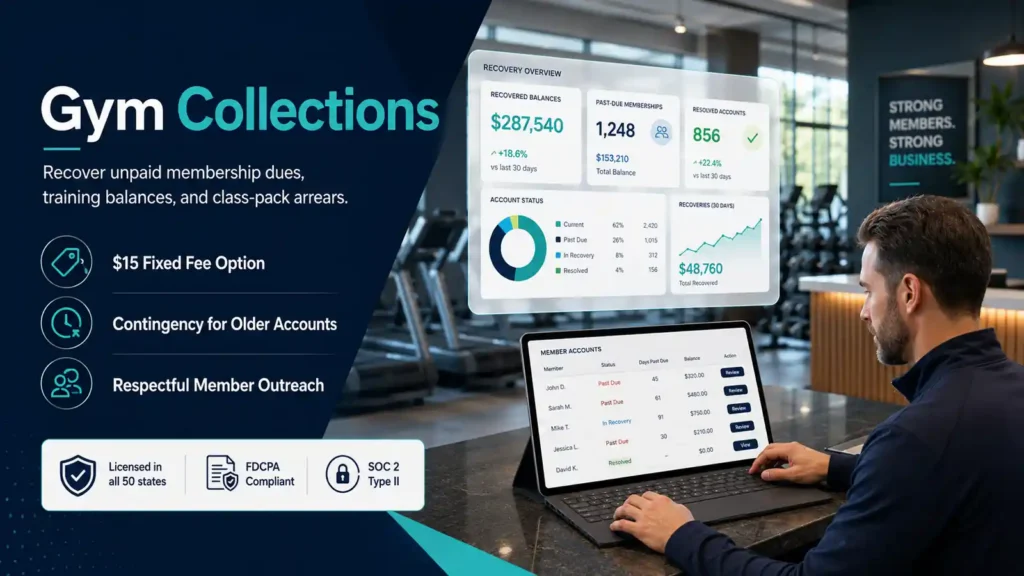
Protecting your Gym’s reputation, Collect911 holds licenses in all 50 states, ensuring a safe approach for every member interaction. We provide free litigation and bankruptcy scrubs with zero onboarding or annual fees. Our SOC 2 Type II and FDCPA-compliant systems ensure total data security, backed by a 4.85/5 rating from over 2,000 professional reviews. Delivering high recovery rates!
Need a Gym Collection Agency? Contact us
The Revenue Recovery Pricing Model
To support gyms of all sizes, our Account Reconciliation Team offers a transparent, performance-based pricing structure. This allows fitness centers to choose the model that best fits their current cash flow requirements while utilizing a professional collection agency framework.
-
Fixed-Fee: $15 per account (The gym keeps 100% of the recovered recovery).
-
Contingency: 40% (No recovery, no fee for older or more difficult balances).

The “CPA Edge” is a critical component of this model. Most accountants recognize the $15 flat fee as a fully tax-deductible business expense, effectively neutralizing the cost of professional intervention while securing the gym’s future revenue [Internal Revenue Service 2024].
Clinical Philosophy: Urgent, Effective, and Respectful
Our philosophy as an “Account Reconciliation Team” is built on being Urgent, Effective, and Respectful. We understand that a gym is a community, not just a business. Our “Peace of Office” benefit allows your front desk staff to focus on wellness and member care rather than the burnout associated with asking for past-due balances.
By acting as a professional concierge, we utilize a “Respectful Friction” model. We position ourselves as helpful mediators who clear “billing static” rather than as an aggressive collection agency. This approach is bolstered by our bilingual outreach specialists, ensuring that Spanish-speaking members are served with the same inclusivity and clarity, leading to faster resolutions nationwide.
Recent Recovery Result: Case Study
-
The Case: A national franchise group with 12 locations faced $140,000 in uncollected annual dues across its member base.
-
The Respectful Intervention: Our team initiated a systematic “Member Reconciliation” campaign, framing the outreach as a courtesy check on payment method expiration.
-
The Financial Result: We recovered $112,000 within the first 60 days, with 82% of those members choosing to update their billing and remain active in their local clubs [Fitness Business Weekly 2025].
The Security & Integrity Suite
Integrity is the cornerstone of our operations. Before any outreach begins, every account is processed through our “Member Scrub” protocol. This includes a litigation check, bankruptcy check, USPS verification, and skip tracing. The litigation check is a vital shield, protecting your gym from members who have a documented history of filing predatory lawsuits against businesses. Furthermore, all calls are recorded and audited for quality control, preventing “review-bombing” and ensuring your gym’s reputation remains untarnished throughout the process.
Regulatory & Compliance Deep-Dive
Operating as a nationwide collection agency requires a deep understanding of evolving federal and state laws. Regulatory bodies have placed significant hurdles on traditional credit reporting, making our “mediation-first” strategy essential [Consumer Financial Protection Bureau 2025]. By focusing on professional dialogue and transparent account reconciliation, we bypass the friction of old-school tactics, staying fully compliant while delivering high-conversion results for our clients.
Areas of Professional Expertise
-
Monthly Membership Dues Reconciliation
-
Unpaid Personal Training & Coaching Balances
-
Boutique Fitness Class Pack Arrears
-
Corporate Wellness Account Recovery
-
Spa and Ancillary Service Billing
-
Lapsed Membership Account Resolution
Frequently Asked Questions
If a member stops the automatic debit, does that cancel the gym membership?
No. Stopping an ACH debit or recurring bank payment stops that payment method; it does not automatically terminate the underlying gym contract. The CFPB specifically uses gym memberships as an example and advises consumers that they must cancel the contract with the company separately. Before referring the account to collections, the gym should therefore determine whether the member actually submitted a valid cancellation or merely blocked the payment.
Can a gym send an account to collections when the member says they already cancelled?
Potentially, but the cancellation dispute should be reviewed first. Check the signed membership agreement, cancellation date, method of cancellation, emails or portal records, required notice period, and applicable state health-club laws. Some states give members specific cancellation rights for matters such as relocation, disability, club closure, or a short cooling-off period. A balance should not be treated as valid simply because recurring billing continued after the member claims to have cancelled.
What records should a gym keep before referring unpaid memberships to collections?
A strong collection file should include the signed or electronically accepted membership agreement, member identity and contact information, transaction or enrollment date, dues and fee schedule, payment history, failed-payment records, cancellation terms, and any cancellation or dispute correspondence. CFPB debt-validation rules specifically contemplate gym membership debts and recognize the membership-contract execution date as a possible transaction date for identifying the debt. Good documentation makes it much easier to verify the balance if the member disputes it.
Can unpaid personal-training sessions or class packages be collected separately from monthly membership dues?
Yes, when those charges arise from an enforceable agreement and the amount owed can be documented. Personal training, coaching, class packs, and ancillary services may have different cancellation, expiration, refund, or payment terms from the basic gym membership. Before submitting them, the gym should separate each type of balance and retain the agreement showing what the member purchased, what was delivered or made available, and how any remaining amount was calculated.
What happens when a member formally disputes a gym debt after it reaches a collection agency?
If a consumer sends a qualifying written dispute within the federal validation period, the debt collector generally must stop collection of the disputed debt or portion until verification is provided. This is why gyms benefit from supplying the membership contract, account history, payments, cancellation records, and balance calculation when the account is first placed instead of trying to reconstruct the file after a dispute arrives.
Can a member still owe gym dues after moving away or becoming unable to use the facility?
It depends on the contract and the state governing the membership. Some state health-club laws give consumers special cancellation rights when they move a specified distance away, suffer a qualifying disability, or when the club relocates or closes. Other situations depend mainly on the written contract. Before pursuing a relocated or medically unable member, the gym should check the applicable state cancellation rule rather than assuming the remaining contract balance is collectible.
Get a Free Recovery Quote
No setup fees. No long-term contracts. Just results.