
Running a business or medical practice in Texas means navigating a high-growth environment with very specific legal boundaries. When an invoice goes unpaid, it isn’t just a line item; it’s a threat to your ability to scale.
At Collect911, we don’t believe in “one-size-fits-all” collections. We’ve built a tiered, four-step system designed to maximize recovery based on the age of the debt, all while keeping you fully compliant with the unique hurdles of Texas law.
The Texas Legal Reality: Why Specialized Knowledge Wins
Texas is famously “debtor-friendly,” but that doesn’t mean you can’t collect. It just means you have to be smarter than the competition.
-
The TDCA Shield:
The Texas Debt Collection Act (TDCA) is stricter than federal law because it applies to both third-party agencies and original creditors. We act as your compliance buffer, ensuring every demand letter and phone call stays within the “Safe Harbor” to protect you from retaliatory lawsuits. -
Anti-Garnishment Expertise:
Texas law (Article 16, Section 28) prohibits wage garnishment for consumer and medical debts. While other agencies might hit a wall here, we pivot to Commercial Credit reporting and Bank Levies. By impacting a debtor’s creditworthiness, we create a far more powerful incentive for them to pay you first. -
The 4-Year Window:
Per Texas Civil Practice & Remedies Code § 16.004, you have exactly four years to file a lawsuit for a debt. However, collectability drops by 15% every 30 days. We monitor these dates with surgical precision so your rights never expire.
Need a Collection Agency? Contact us
The Science of Timing: Steps 1 through 4
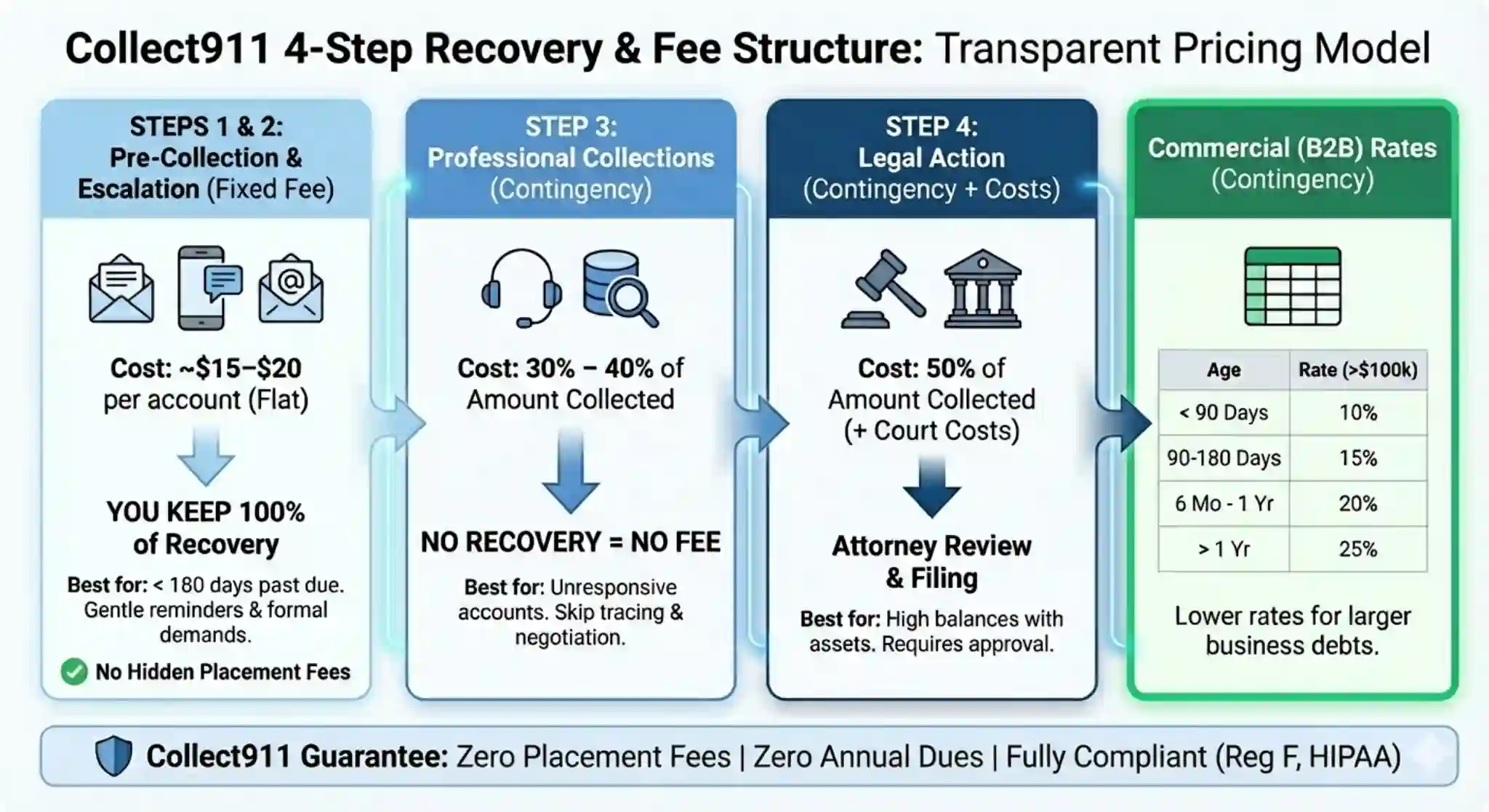
We break our process into two phases: Pre-Collection (Fixed Fee) and Full Collection (Contingency).
Phase 1: High-Impact Demand (Steps 1 & 2)
For “fresh” debts (less than 180 days old), the goal is a firm, professional reminder.
-
The Power of the Letter: A formal third-party demand letter is incredibly effective for early-stage debt. It signals that the account has escalated.
-
Fixed-Fee Savings: We offer these steps at a low, flat fee. You keep 100% of the recovered funds. This is the gold standard for San Antonio medical practices or El Paso wholesalers looking to clear their books cost-effectively.
Phase 2: Intensive Recovery (Steps 3 & 4)
Once a debt crosses the 120-to-180-day threshold, the “polite nudge” is over.
-
Deep Research: We use advanced skip-tracing to locate non-exempt assets and decision-makers.
-
Leverage: We report to major credit bureaus. A dip in a Texas business’s credit score can freeze their ability to get inventory or equipment leases, making your invoice their top priority.
-
No Recovery, No Fee: We shoulder the risk. If we don’t collect, you pay $0.
Why Medical Practices in Texas Trust Us
Healthcare providers face a double-edged sword: collecting from patients while maintaining a “caring” brand image. Between HIPAA regulations and the risk of negative Yelp reviews, the stakes are high.
-
Compliant Communication: Our staff is trained in TCPA and FDCPA protocols. We know exactly how to contact a patient without triggering a legal headache for your practice.
-
The 4.85 Google Factor: We are proud of our 4.85-star rating because 90% of our positive reviews come from the debtors themselves. We treat people with dignity, providing secure portals and respectful payment options that protect your local reputation.
Texas generally protects current wages from garnishment for ordinary medical debt. Our patient-account strategy therefore focuses first on compliant communication and voluntary resolution. Commercial credit reporting is reserved for eligible B2B accounts and should not be confused with consumer medical debt recovery.
B2B Collections: The Commercial Advantage
For Texas B2B providers, “the check is in the mail” is often a stall tactic used to manage their cash flow at the expense of yours. We specialize in “Piercing the Corporate Veil.” We find the CFOs and owners, using commercial credit reporting (Dun & Bradstreet, Experian Business) to ensure that ignoring your bill has real-world consequences for their business operations.
Data-Driven Security
-
Statute of Limitations: We monitor Texas’s 4-year statute on written contracts so you never miss a legal window to collect.
-
Encryption: All account data is protected by 256-bit encryption with Two-Factor Authentication (2FA). Your data security is non-negotiable.
Recent Recovery Results
Houston Diagnostic Imaging Center — Fixed Fee — 66% Recovered
A Houston imaging center found $17,250 in smaller patient-responsibility balances scattered across its aging report. The claims had been adjudicated, EOB amounts matched the patient ledger, and itemized bills had already been issued.
Rather than consuming staff time with another cycle of calls, the center moved the accounts into the fixed-fee recovery program.
Placed: $17,250
Recovered: $11,385
Recovery Rate: 66%
The result was particularly useful because these were numerous smaller balances where a high contingency percentage would have reduced the economics of collection.
Dallas Orthopedic Group — Contingency — 53% Recovered
A Dallas orthopedic group had $38,400 in older deductible and coinsurance balances from patients who had already received multiple statements and stopped responding.
After the billing team verified patient responsibility and removed unresolved insurance accounts, the remaining portfolio moved to contingency collections.
Placed: $38,400
Recovered: $20,352
Recovery Rate: 53%
The group incurred collection fees only on recovered money, making the approach suitable for accounts that had already exhausted normal internal follow-up.
San Antonio Multi-Specialty Practice — Fixed Fee + Contingency — 47% Recovered
A San Antonio medical group approached its aging A/R differently. Instead of sending every delinquent account into the same collection channel, it split $27,900 in verified patient balances by age and prior payment behavior.
Recent balances received fixed-fee intervention first. Accounts that remained unresolved were escalated to contingency recovery.
Placed: $27,900
Recovered: $13,113
Recovery Rate: 47%
The practice recovered nearly half of the portfolio while reserving higher-cost contingency work for the accounts that genuinely needed it.
Frequently Asked Questions:
Can a Texas medical provider send a patient to collections before providing an itemized bill?
No. Texas Health and Safety Code Chapter 185 requires covered healthcare providers to issue an itemized bill showing the services and supplies provided and the amount alleged to be due from the patient. The law specifically states that a healthcare provider may not pursue debt collection for the healthcare service or supply unless it has complied with these itemized-billing requirements. For a medical practice, this makes the itemized bill an important part of the collection file—not simply a document produced after a patient disputes the balance.
Is posting a Texas patient’s itemized medical bill only in a patient portal enough?
Not always. Texas law addresses electronic delivery through patient portals. When a provider issues an itemized bill through a portal, it should determine whether the patient has an active portal profile when feasible. If the patient does not have an active profile—or the provider cannot determine whether one exists—the provider must also mail, email, or provide a physical copy according to the patient’s chosen method of delivery. That makes delivery documentation especially important before an unpaid balance is referred for collection.
Can an out-of-network Texas medical bill be collected from the patient if surprise-billing protections apply?
Only the legitimate patient-responsibility amount should be pursued. Texas and federal surprise-billing laws prohibit balance billing in several situations, including qualifying emergency care and certain out-of-network services received when the patient did not have a meaningful choice of provider. For Texas-regulated plans, the patient generally remains responsible for the applicable deductible, copayment, or coinsurance—not the prohibited out-of-network balance. Providers should therefore verify the EOB and applicable surprise-billing protections before transferring the balance to collections.
What changed in Texas in 2025 for uninsured patients paying hospital bills directly?
Beginning September 1, 2025, Texas requires a hospital to allow a patient who is not enrolled in a health benefit plan to request a direct full-payment option for qualifying hospital services. The request generally must be made within 60 days after the patient receives the bill or final accounting, and the bill must notify the patient of this option. The amount the hospital can charge under this provision is subject to statutory limits tied to amounts generally billed or certain contracted rates. Charity-care eligibility is not eliminated by choosing or considering this option.
How long does a Texas medical provider generally have to sue over an unpaid patient debt?
Texas generally provides a four-year limitations period for an action on a debt, measured from when the cause of action accrues. The exact accrual date can depend on the account documents and circumstances, so medical practices should not assume that every balance expires exactly four years after the date of treatment. From a collection standpoint, waiting until an account approaches the limitations deadline also leaves fewer recovery options and makes documentation harder to locate.
Can a Texas patient’s wages be garnished after a medical debt judgment?
Ordinary current wages are generally protected from garnishment in Texas. Texas Civil Practice and Remedies Code Section 63.004 states that current wages for personal services are not subject to garnishment except where state or federal law provides otherwise. That means a medical creditor should not assume that obtaining a judgment automatically allows it to garnish the patient’s paycheck. Other lawful post-judgment remedies may depend on whether the debtor has non-exempt assets and on the specific facts of the case.
Serving the Entire Lone Star State
From the tech hubs of Austin to the energy corridors of Houston and the logistics centers of DFW, Collect911 provides a localized, professional presence. We are licensed in all 50 states, so if your debtor leaves Texas, we follow the debt until it’s resolved.
Your focus should be on growing your business, not chasing old money.