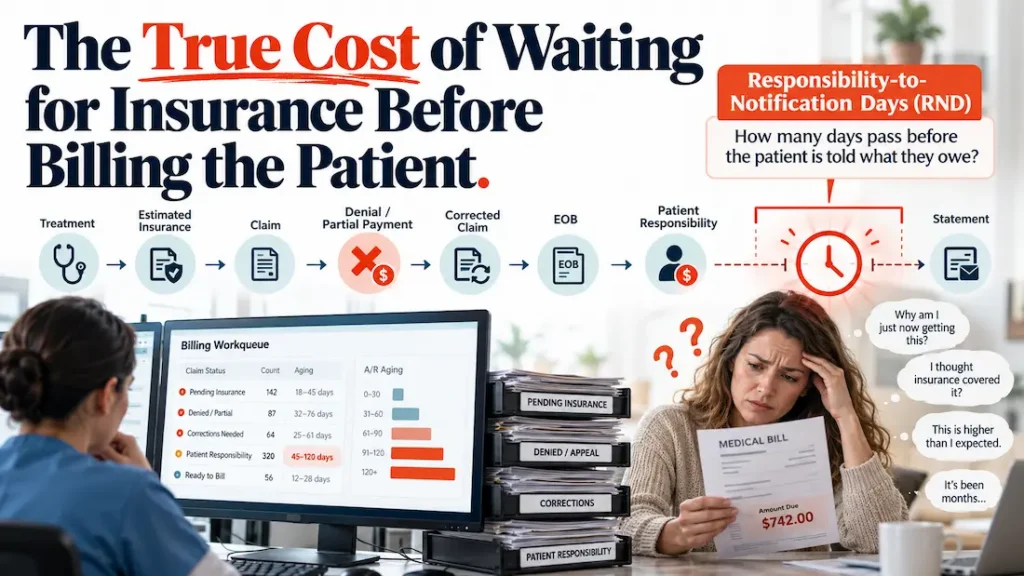
Responsibility-to-Notification Days (RND) is a patient revenue-cycle metric that counts the days between the date a patient’s balance becomes actionable after insurance adjudication and the date the patient is first told what they owe. Collect911 proposes RND as a second aging clock that sits alongside traditional date-of-service aging.
Quick answer: Date-of-service aging mixes two very different kinds of time: the weeks a claim spends with the insurer, and the days a known patient balance sits before anyone tells the patient. RND isolates the second period, which is the part a practice largely controls. The rule it supports is simple: don’t bill until the patient’s amount is accurate, but once it is, don’t let the balance age out of sight. Collect911 introduced Responsibility-to-Notification Days (RND) as a framework for measuring the controllable delay between established patient responsibility and first patient notification.
.
A patient is treated on January 8. The claim goes out on January 12, comes back partly denied, gets corrected and resubmitted, and final adjudication arrives on March 3: the patient owes $684.
The first statement goes out on March 24.
Your system says the balance is 75 days old. The patient says it’s Day 1. They didn’t know they owed $684 in January. Neither did you.
Both views are right, because they’re measuring different clocks. The practice had little control over the first 54 days. It had almost complete control over the last 21.
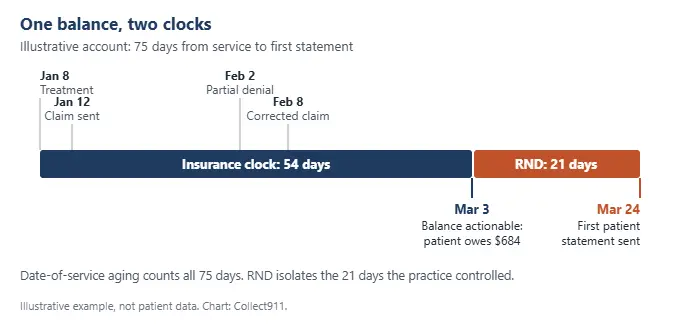
Those 21 days are the Responsibility-to-Notification Gap, and most A/R reports never show them.
One Clock Is Hiding Two Different Problems
| Clock 1: Date-of-service aging | Clock 2: Responsibility-to-Notification Days | |
|---|---|---|
| Starts | Date of service | Actionable patient responsibility date |
| Ends | Today, or resolution | First patient notification |
| Mostly controlled by | The payer, plus claim quality | The provider’s billing process |
| What it tells you | How old the encounter is | How long a known balance sat before the patient heard about it |
Waiting for the insurer is often exactly the right thing to do. Claim adjudication is anything but a formality:
- HealthCare.gov insurers denied 19% of in-network claims and 37% of out-of-network claims in 2024, according to KFF’s analysis of federal data. Administrative reasons made up 25% of the in-network denial reasons insurers reported. KFF’s figures cover only HealthCare.gov marketplace plans, and claims that were denied and then resubmitted and paid aren’t counted as denials, so they don’t capture the full correction workload.
- In one research study of insurance claims data, the time from service to the insurer paying its share averaged 3.9 weeks, and roughly 40% of bills took longer than a month to settle.
- For many private health plans, federal claims rules give the plan up to 60 days to decide an internal appeal of a post-service claim.
None of that is the practice being slow. The problem starts when the insurance uncertainty has ended and the patient billing hasn’t begun.
When Does the RND Clock Start?
Not when insurance pays, and not when the EOB is mailed. It starts on the Actionable Patient Responsibility Date: the earliest date the provider has enough adjudication and account information to bill the patient an accurate amount.
Two pieces of federal guidance frame that moment:
- The EOB is not a bill. CMS’s own consumer guidance says so plainly. The EOB explains how the plan processed the claim, and the provider’s statement is the actual request for payment.
- The remittance tells the provider who owes what. On Medicare’s electronic or paper remittance advice, adjustments carrying the PR (patient responsibility) group code identify amounts assigned to the patient.
A balance is actionable when all five of these are true:
| Check | Why it matters |
|---|---|
| Payer adjudication received | You know what the plan paid and why |
| Contractual adjustments applied | The patient isn’t billed for amounts written off by contract |
| Known secondary coverage processed or addressed | A secondary payer may still owe part of it |
| No active correction, reconsideration or appeal likely to change the amount | A pending fix makes today’s balance wrong |
| Balance reconciled against payments already made | Copays collected at check-in are credited |
The last point is where RND protects against the opposite mistake. HFMA’s Patient Friendly Billing principles call for patient financial communications that are clear, concise, correct and patient friendly. A first denial is not patient responsibility. Billing a patient $1,200 for a claim your team is already correcting doesn’t speed anything up; it generates a dispute. RND measures avoidable delay, not necessary delay.
How to Calculate RND
RND = First Patient Notification Date − Actionable Patient Responsibility Date
If responsibility became actionable on May 10 and the first statement went out May 16, RND is 6 days.
Two definitions to settle before you track it:
- What counts as “notification.” A statement generated, a statement transmitted, a verified portal notice or a documented billing call that states the amount. Pick one and use it every time.
- Sent vs. delivered. A statement dropped in the mail stream isn’t the moment the patient learns about the balance. Where you can measure it, track both dates.
Report RND as a distribution, not a single average: the share of balances notified within 0–3, 4–7, 8–14, 15–30 and 31+ days. Treat these as measurement bands, not grades. No validated national benchmark exists yet, and a specialty with complex coordination of benefits may legitimately run longer than a primary-care group.
What the Gap Costs
Memory fades. A patient billed soon after adjudication remembers the visit, what they paid at the desk and which plan they used. Months later, the first call isn’t “How do I pay this?” It’s “What is this bill?” Your staff then has to reconstruct an encounter the patient barely recalls.
Errors surface later. CMS tells patients to compare the provider bill with the EOB and to question amounts that don’t match. A timely statement gives both sides an earlier chance to catch a missing insurance payment, a wrong plan, an unapplied copay or a misposted adjustment. The goal isn’t only to collect sooner. It’s to resolve sooner.
The first statement may carry more weight than it looks. A 2025 JAMA Health Forum study of patient accounts at 217 U.S. hospitals found pre-pandemic repayment of owed cost sharing averaged about 54% and has declined since. It also found that patients with private insurance paid either none or all of what they owed in 92.2% of cases (94.1% for Medicare Advantage). The authors note that the lag between care and billing can create confusion and may weaken the impetus to pay. If payment is largely all-or-nothing, the first clear, accurate statement may be where much of that decision gets made. That’s a hypothesis RND data can test, not a proven fact.
The First Bill Starts Other Clocks, Too
Your internal aging date isn’t the only timeline in play. Several rules key off notification or collection events, not the date of service:
- Nonprofit hospitals (IRC §501(r)). Covered hospital facilities generally can’t begin certain extraordinary collection actions until 120 days after the first post-discharge billing statement, and must process financial assistance applications submitted within 240 days of that statement.
- State pre-collection notices. Some states require written notice before a collection agency can pursue medical debt. Nevada, for example, requires a collection agency to send written notice at least 60 days before taking action to collect a medical debt (see our Nevada medical collections page). Indiana’s House Enrolled Act 1271 adds a financial-assistance notice requirement before collections, effective July 1, 2026 (see our Indiana medical collections page).
- Credit reporting. Under the three national credit bureaus’ own voluntary policies, unpaid medical collection debt has a one-year waiting period before it can appear on a credit report, and paid medical collections and balances under $500 are excluded.
Rules vary by provider type and state, and they change. The practical point: when the first bill actually went out is a date you’ll want to be able to prove.
Patient Awareness Age: The Companion Metric
RND leads to a second useful number. Patient Awareness Age is the number of days since the patient was first notified of an established balance.
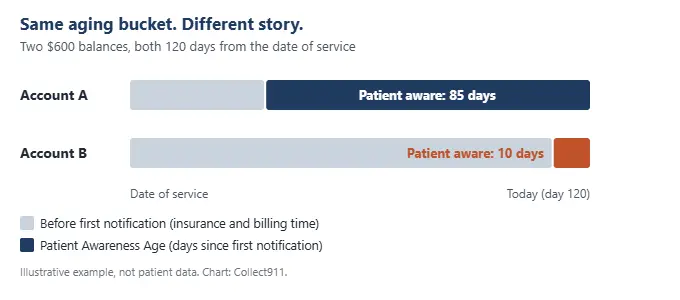
Both accounts above sit in the same 120-day aging bucket. One patient has known about the balance for nearly three months; the other found out ten days ago. They may not warrant the same next step. The 90-day collection rule still holds as a signal that follow-up has stalled, but it tells you far more when it’s counted from awareness, not from the date of service.
Insurance time should not quietly become patient time. A claim can be 90 days old without the patient having had 90 days to deal with an accurate bill.
Before an Account Goes to Collections
A collection agency should sit downstream of a documented billing process. Before placement, your team should be able to answer:
- When did patient responsibility become actionable, and how was the amount determined?
- When was the patient first notified, and how many follow-ups followed?
- Were any statements returned as undeliverable?
- Is any insurance question still open, or is the balance disputed?
- Was financial assistance relevant, and was it offered where required?
- Has the account been reviewed against your placement policy?
An account 180 days from service but only 40 days from first notification tells a very different story from one billed consistently for six months. That history shapes how an agency approaches the patient, so send the key dates along with every placement, whether accounts reach our medical and hospital collections team by upload or through an integration such as Athenahealth.
Start Tracking: Five Dates, Three Intervals
You don’t need a benchmark to start. Record five dates on every patient-responsibility account:
| Date | What it marks |
|---|---|
| Date of service | When care was provided |
| Initial claim date | When the claim was first submitted |
| Actionable responsibility date | When the patient amount became accurate enough to bill |
| First notification date | When the patient was first told |
| Resolution date | Paid, adjusted, on a plan, placed or otherwise closed |
Those five dates produce three intervals that show where the time actually goes:
- Insurance resolution time = actionable responsibility date − initial claim date
- Responsibility-to-Notification Days = first notification date − actionable responsibility date
- Patient resolution time = resolution date − first notification date
Two practices with identical 60-day insurance cycles can look the same on a payer A/R report. If one notifies patients in 2 days and the other in 23, RND shows the difference immediately.
What an RND Benchmark Could Eventually Show
With enough anonymized accounts, Collect911 plans to study median RND and its spread, RND by specialty and balance size, clean claims versus corrected claims, and, most importantly, whether shorter RND is associated with differences in payment rates, disputes, payment-plan enrollment and collection placement. No standard will be published before the data supports one. If short RND turns out to matter, we’ll publish that. If it doesn’t, we’ll publish that too.
Frequently Asked Questions
What are Responsibility-to-Notification Days in medical billing?
Responsibility-to-Notification Days, or RND, is the number of days between the date a provider has enough adjudication information to bill an accurate patient balance and the date the patient is first notified of that balance. It separates avoidable billing delay from time spent waiting on the insurer.
When does the RND clock start?
The clock starts on the actionable patient responsibility date, not the date insurance pays or the first denial. That is the earliest date payer adjudication is received, contractual adjustments are applied, known secondary coverage is addressed, no correction or appeal is expected to change the amount, and prior payments are credited.
What is the difference between an EOB and a medical bill?
An Explanation of Benefits comes from the health plan and explains how a claim was processed, including what the plan paid and what may be the patient’s share. It is not a bill. The provider’s statement is the request for payment, and CMS advises patients to compare the two.
Is date of service the best way to age a patient balance?
Date of service is useful, but it doesn’t tell the whole story. An insured account can spend weeks or months in payer processing before the patient’s amount is known. Tracking date-of-service age alongside RND and Patient Awareness Age shows how much of an account’s age belongs to the insurer, the billing office and the patient.
What is a good Responsibility-to-Notification Days score?
There is no validated universal RND benchmark yet, and specialties with complex billing may legitimately run longer. Start by measuring your own distribution across bands such as 0–3, 4–7, 8–14, 15–30 and 31+ days, then work on the accounts in the longest bands.
Should patient balances go to collections based on date of service alone?
Date of service matters, but it shouldn’t be the only factor. Before placement, providers should also consider when accurate responsibility was established, when the patient was first notified, whether any insurance question or dispute is open, and what financial assistance or state notice requirements apply to the account.
Balance Notification & Validation: Regulatory Safeguards
-
Regulation F 5-Day Validation Notice (12 CFR § 1006.34): A collector must deliver a formal written or electronic validation notice within 5 days of initial contact. This disclosure itemizes the balance and triggers the debtor’s statutory 30-day window to dispute the debt or request creditor verification before outreach escalates.
-
No Surprises Act Balance Notice Rules (45 CFR § 149.440): Healthcare providers must issue patient-responsibility statements promptly after insurer adjudication. Delaying patient notification past statutory billing windows violates federal price transparency rules, increases dispute exposure, and risks forfeiting out-of-network balance collection rights.
-
Commercial Timely Objection Principles (Account Stated): In B2B transactions, prompt delivery of formal invoice notices establishes an enforceable “account stated.” Delaying notification enables business debtors to raise late disputes over goods or services, weakening recovery claims in litigation.
The Collect911 Principle
Don’t bill the patient before you know what they reasonably owe. Once you know, don’t let the balance age invisibly.
Measure the moment responsibility becomes actionable. Measure the moment the patient is told. Then measure the gap. That gap is Responsibility-to-Notification Days, and it may be one of the most overlooked numbers in the patient revenue cycle.
Want to see how your patient balances look through both clocks? Call Collect911 at 1-844-666-7890 or contact us. Pricing details are on our pricing page.
Sources
- KFF, Claims Denials and Appeals in ACA Marketplace Plans in 2024
- CMS, Reading Your Explanation of Benefits (EOB)
- Ippolito, Trish, Duffy and Vabson, Patient Repayment of US Hospital Bills From 2018 to 2024, JAMA Health Forum (2025)
- Medical Bill Shock and Imperfect Moral Hazard, working paper (service-to-adjudication wait times)
- HFMA, Patient Friendly Billing principles
- 26 CFR §1.501(r)-6 (billing and collection rules for nonprofit hospital facilities); 29 CFR §2560.503-1 (group health plan claims and appeals procedures)
Published September 2026 | Collect911 Revenue-Cycle Insights
This article discusses revenue-cycle measurement and operational practice and is not legal advice. Billing, insurance, financial-assistance and debt-collection requirements vary by provider type, payer, state and individual account.