The U.S. debt collection industry is entering an interesting phase. While the Trump administration provided considerable regulatory relief to collection agencies during 2025–2026, Democratic gains in the November 2026 midterm elections could bring a new wave of consumer protection laws, particularly at the state level.
The next two years could present a rather unusual situation: less regulatory pressure from Washington, but more from individual states and private consumer litigation.
Healthcare providers, businesses and collection agencies should prepare for a potentially more fragmented regulatory environment.
How the Trump Administration Helped Collection Agencies
Several federal regulatory developments during 2025–2026 have been favorable to the collection industry.
| Regulatory development | Benefit to collection agencies |
|---|---|
| Reversal of Biden’s medical debt credit reporting rule | Preserved credit reporting for eligible medical debts. |
| Broader interpretation of FCRA preemption | Strengthened legal challenges against restrictive state credit reporting laws. |
| Reduced CFPB supervision | Targeted a 50% reduction in supervisory activities. |
| Withdrawal of restrictive advisory opinions | Reduced additional regulatory guidance concerning medical debt, convenience fees and time-barred debts. |
| Review of the $10 million CFPB supervision threshold | Potential regulatory relief for midsized collection agencies, if adopted. |
| TCPA consent-revocation changes | Simplified certain automated communication requirements, effective November 25, 2026. |
Perhaps the biggest relief came on July 11, 2025, when a federal court overturned the Biden administration’s medical debt credit reporting rule, following a joint request from the CFPB and the plaintiffs.
However, existing credit bureau restrictions on paid medical debts, medical debts initially under $500 and those less than one year old remain separate from this decision.
How the 2026 Midterm Election Results May Change Things
The November 2026 elections significantly changed the political balance across the country.
| Political institution | Post-election outlook |
|---|---|
| U.S. Senate | 56–44 Democratic majority, including caucusing independents |
| U.S. House | Democratic majority |
| State governors | 30 Democrats, 20 Republicans |
| State legislative chambers | 12 additional chambers gained by Democrats |
| Democratic state trifectas | Anticipated increase from 16 to 22 states |
| White House | Republican administration |
A state government trifecta means that one political party controls the governorship and both legislative chambers, making it easier to pass legislation.
With President Trump retaining presidential veto power, major federal legislative reversals may be difficult before 2029. However, state governments and attorneys general could become considerably more active in consumer protection.
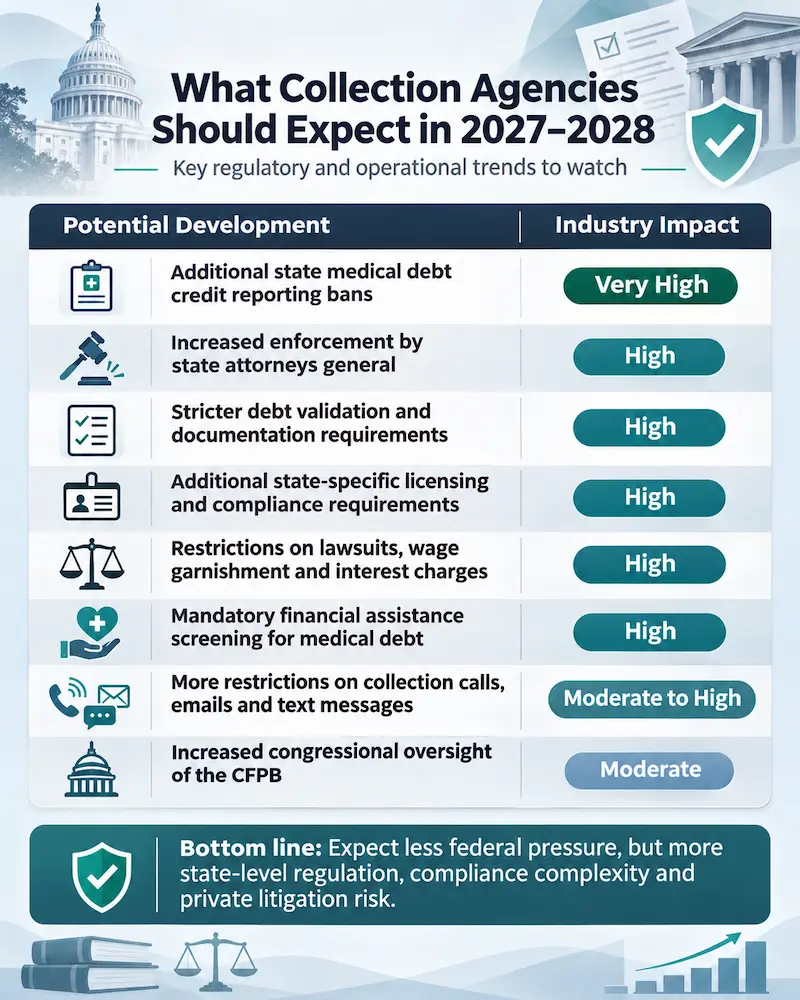
What Collection Agencies Should Expect in 2027–2028
Although these developments are not guaranteed, several areas deserve close attention.
| Potential development | Industry impact |
|---|---|
| Additional state medical debt credit reporting bans | Very high |
| Increased enforcement by state attorneys general | High |
| Stricter debt validation and documentation requirements | High |
| Additional state-specific licensing and compliance requirements | High |
| Restrictions on lawsuits, wage garnishment and interest charges | High |
| Mandatory financial assistance screening for medical debt | High |
| More restrictions on collection calls, emails and text messages | Moderate to high |
| Increased congressional oversight of the CFPB | Moderate |
State-level regulations could become a particularly expensive challenge for nationwide collection agencies. Operating across multiple jurisdictions already requires considerable compliance expertise, technology and employee training.
Federal vs. State Credit Reporting Laws
Credit reporting could become one of the biggest legal battlegrounds for the collection industry.
In October 2025, the CFPB issued an interpretation supporting broader federal preemption under the Fair Credit Reporting Act (FCRA).
On August 10, 2026, a federal court permanently blocked enforcement of a Texas provision restricting the credit reporting of certain medical debts.
Similar legal challenges could potentially overturn other state credit reporting restrictions. However, the outcome may vary by jurisdiction, and agencies must continue complying with applicable state laws.
Private Lawsuits Are Already Increasing
Less aggressive federal enforcement does not necessarily mean fewer lawsuits. Consumers and private attorneys can still pursue legal claims under applicable federal and state laws.
According to WebRecon, consumer litigation increased during the first nine months of 2026 compared with the corresponding period in 2025.
| Category | Year-over-year increase |
|---|---|
| FCRA lawsuits | 43.8% |
| TCPA lawsuits | 13.4% |
| FDCPA lawsuits | 7.2% |
| CFPB complaints | 14.2% |
These figures cover broader consumer litigation involving creditors and other businesses, not exclusively collection agencies.
The numbers are a reminder that regulatory relief does not eliminate compliance responsibilities or private litigation risks.
Why Medical and Dental Collections Could Be More Affected
Medical debt remains a major focus of consumer protection initiatives. Hospitals, dental offices and physician practices could face additional restrictions on how unpaid patient balances are collected.
Potential challenges include:
- Reduced availability of credit reporting as a collection tool.
- Additional patient financial assistance requirements.
- Longer waiting periods before collection activities begin.
- Greater documentation and debt verification requirements.
- Higher collection costs and pressure on recovery rates.
Commercial B2B collections may experience comparatively less direct impact from consumer debt regulations.
How Businesses and Collection Agencies Should Adapt
Traditional collection techniques alone may no longer be sufficient. Businesses should reassess their accounts receivable strategies and collection partners.
- Place overdue accounts early: Avoid allowing unpaid balances to age unnecessarily.
- Maintain accurate documentation: Verify balances, payments, insurance adjustments and supporting records.
- Diversify communication: Use compliant letters, telephone calls, emails, SMS and secure payment portals.
- Offer flexible payment arrangements: Encourage voluntary resolutions rather than relying heavily on credit reporting or litigation.
- Strengthen state-specific compliance: Maintain updated procedures based on applicable local laws.
- Prioritize diplomatic collections: Preserve customer and patient relationships while recovering legitimate receivables.
The Bottom Line
The debt collection industry could experience two opposing regulatory forces in 2027–2028: federal deregulation and increased state-level consumer protection.
While recent federal policies have provided some relief, additional state regulations and rising private litigation could offset those benefits.
For businesses and healthcare providers, working with an experienced, compliance-focused collection agency is becoming increasingly important. Early intervention, modern technology and respectful collection practices may prove more valuable than aggressive recovery techniques.
This industry outlook is based on developments available as of November 21, 2026. Future legislative and judicial outcomes remain uncertain.
Frequently Asked Questions
1. How has the Trump administration helped collection agencies?
The Trump administration supported the reversal of the federal medical debt credit reporting rule, reduced CFPB supervisory priorities, withdrew several restrictive advisory opinions and adopted a broader interpretation of federal credit reporting preemption. These actions may reduce regulatory burdens on collection agencies.
2. How could Democratic control of Congress affect collection agencies?
Democratic control of Congress could increase regulatory oversight, congressional investigations and consumer protection legislative activity. However, presidential veto power may limit major federal legislative changes before 2029.
3. Can states still prohibit medical debt credit reporting?
Yes, states can enact medical debt credit reporting restrictions, although their enforceability may be challenged under the Fair Credit Reporting Act (FCRA). Collection agencies must follow applicable state laws and relevant court decisions.
4. Are FDCPA and FCRA lawsuits increasing?
Yes. According to WebRecon, during January–September 2026, FDCPA lawsuits increased by 7.2% and FCRA lawsuits increased by 43.8% compared with the same period in 2025. These figures cover broader consumer litigation.
5. Will medical debt become harder to collect in 2027–2028?
Medical debt could become harder to collect if states introduce additional credit reporting restrictions, financial assistance requirements or limitations on legal collection activities. The actual impact will depend on future laws, court decisions and collection practices.
6. How can businesses prepare for changing debt collection regulations?
Businesses should place overdue accounts early, maintain accurate documentation, offer flexible payment arrangements and work with collection agencies that maintain strong state-specific compliance procedures and use respectful collection methods.
References
- CFPB – Medical Debt Credit Reporting Rule
- CFPB – Withdrawn Regulatory Guidance
- CFPB – Supervision and Enforcement Priorities
- Federal Register – FCRA Preemption of State Laws
- Federal Regulatory Agenda – Debt Collection Larger Participant Rule
- Federal Register – TCPA Consent-Revocation Changes
- National Conference of State Legislatures – 2026 Election Analysis
- Reuters – 2026 Midterm Election Outlook
- Texas Federal Court – Consumer Data Industry Association v. State of Texas
- WebRecon – September 2026 Litigation Statistics